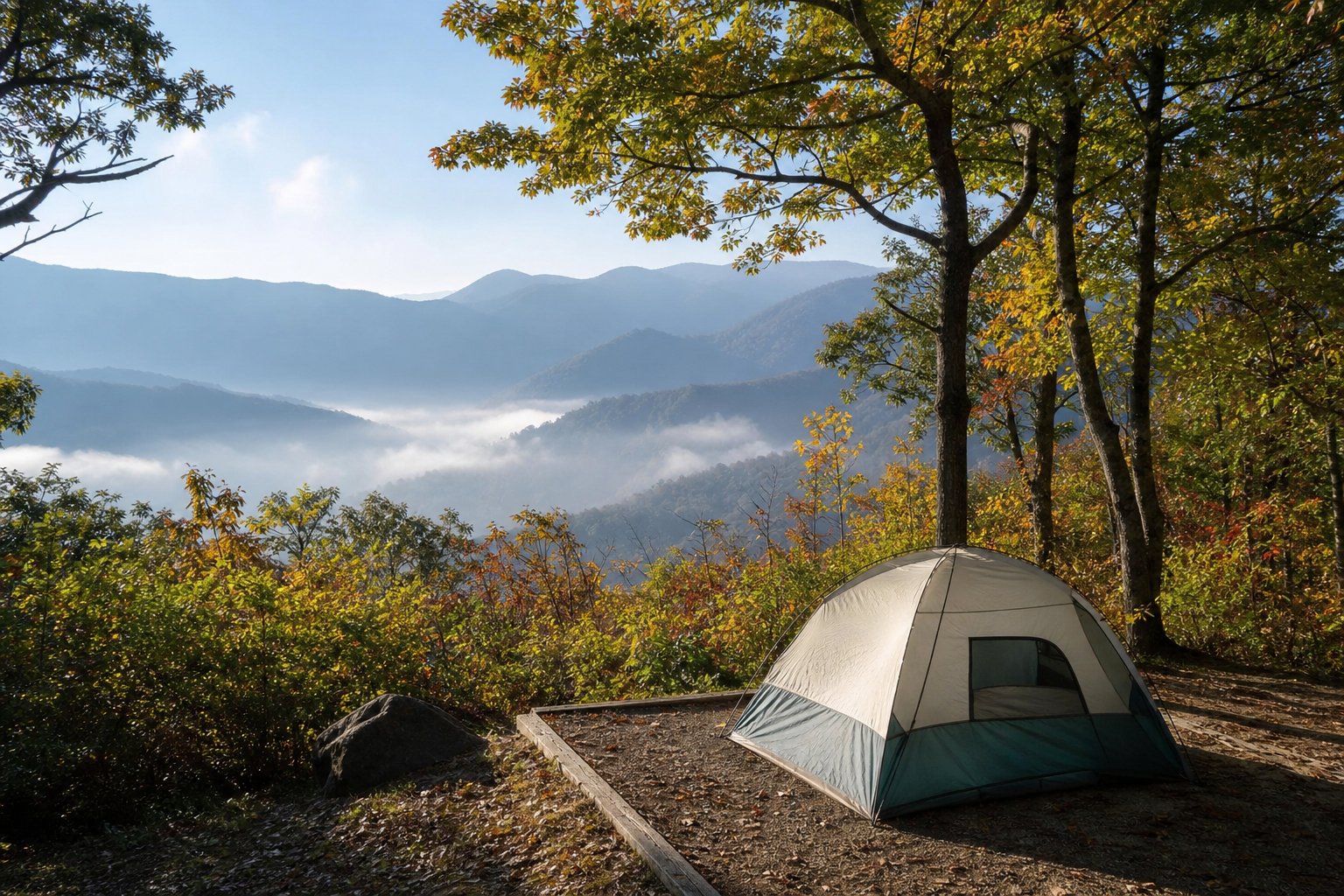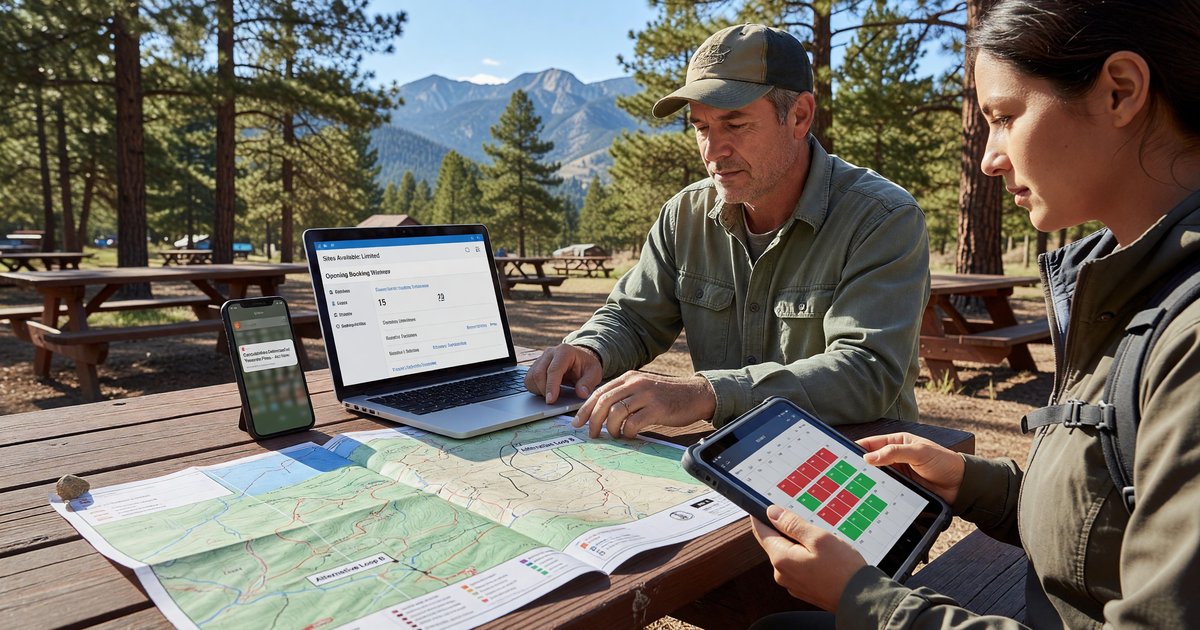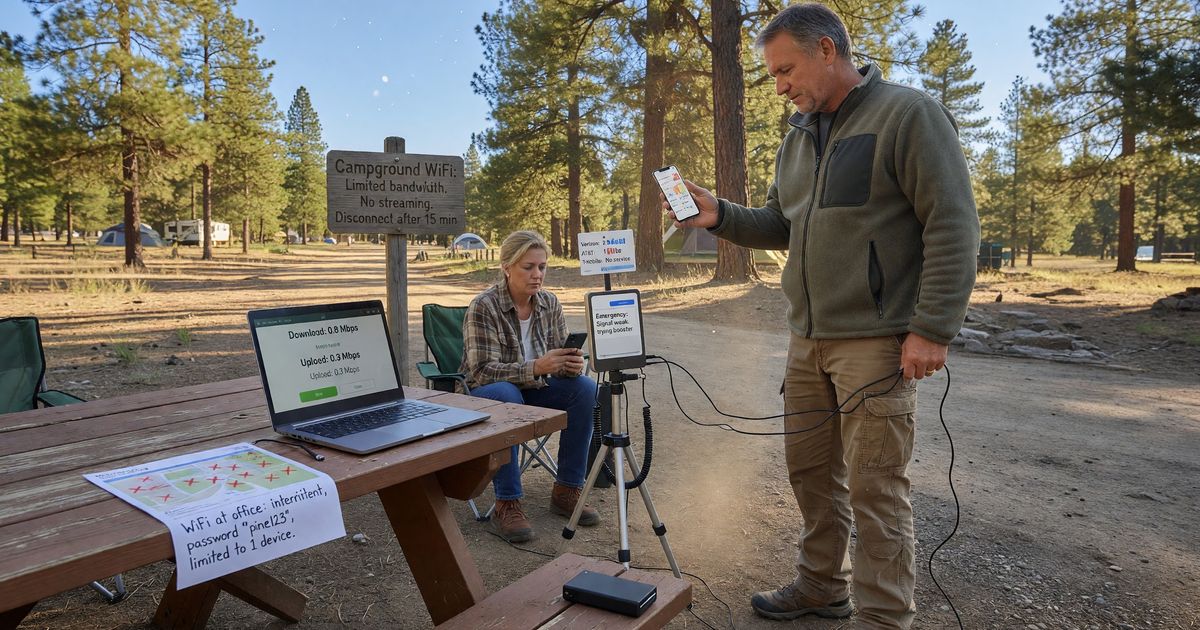
Cell service at campgrounds ranges from surprisingly good to completely absent, and the difference matters more than ever — both for campers who need occasional connectivity and for the growing number of people working remotely from campgrounds and RV parks.
The honest assessment: expecting reliable connectivity at national park campgrounds and remote forest camping is wishful thinking. Expecting adequate coverage at most private campgrounds and many state parks is reasonable. Planning around what is actually available rather than what you hope is available avoids the frustration that comes from discovering the gap at the campsite.
Why Cell Coverage at Campgrounds Is Unreliable
Campgrounds are often in exactly the wrong places for cellular coverage. Mountains, canyons, dense forest, and remote valleys block signal propagation. Cell towers are built where the population density justifies the infrastructure cost — which is rarely in wilderness recreation areas. The few towers that exist near popular parks and campgrounds become overloaded during summer peak use, delivering congested, slow connectivity even where signal strength is nominally adequate.
Additionally, national parks have historically opposed tall infrastructure in scenic viewsheds, which limits tower placement near park campgrounds specifically.
Carrier Coverage: Which Networks Work Better
Coverage at any specific campground is highly location-dependent, but some patterns hold:
Verizon has historically had the strongest rural and wilderness coverage in the United States, particularly in the western states. For camping connectivity specifically, Verizon's rural network advantage is real and measurable. If connectivity is important to your camping, a Verizon plan is the practical choice.
AT&T has comparable or stronger coverage in the southeast and portions of the mid-Atlantic. In the Mountain West and Pacific Northwest, Verizon's coverage advantage tends to widen.
T-Mobile (including former Sprint coverage) has expanded significantly in recent years and now has strong coverage in many areas that historically had only Verizon. Their coverage in remote areas still trails Verizon in many western locations but is competitive in less remote campground settings.
The only reliable way to check coverage at a specific campground is to consult the carrier's coverage map for that exact location, then read user reviews mentioning connectivity (reviews on recreation.gov, campsite-specific forums, and RV community sites often mention cell coverage explicitly).
Campground WiFi: What to Actually Expect
Private campgrounds increasingly offer WiFi. What this means in practice varies enormously.
Common reality at most campgrounds: A single access point or a small network of access points serving dozens or hundreds of campsites. The bandwidth per site during peak hours is rarely adequate for streaming video or video conferencing. Web browsing and email typically work. Netflix and Zoom typically do not, or work intermittently.
Better-equipped private parks: Some upscale private campgrounds and resort-style RV parks invest in fiber-connected, campsite-level infrastructure — individual access points or cable connections per site rather than a shared wireless network for the loop. These are the exception and are usually not clearly marketed as such. The most reliable signal is asking other campers on the site whether they found the WiFi usable.
State and national park campgrounds: Most do not have WiFi at all at campground sites. Visitor centers may have WiFi. Do not plan on campground WiFi at park campgrounds.
Signal Boosters: Do They Work?
Signal boosters (from brands including WeBoost, SureCall, and others) amplify existing cellular signal. The key word is "amplify" — a booster cannot create signal where there is none. It can meaningfully improve a weak signal in areas where you have some signal and need more.
In practice, a quality external booster (not the magnetic-mount OTA style) mounted on an RV exterior with a directional antenna can pull in usable signal from towers that are far enough away to produce only weak readings on a phone. In areas with complete dead zones, a booster provides no benefit.
For camping connectivity specifically, a booster is a useful addition if you frequently camp in areas with marginal coverage. It is not a solution for consistent off-grid connectivity needs.
Hotspot Plans and Cellular Data for RV Use
For work-from-campground users, the practical connectivity solution is a cellular hotspot on a plan with adequate data.
Unlimited hotspot plans: Carriers offer unlimited plans with varying amounts of "premium" (full-speed) hotspot data before throttling. Verizon and AT&T's unlimited plans include 30-50+ GB of premium hotspot data per month on upper-tier plans. After the premium allotment, speeds drop to 3G equivalent (adequate for email and basic browsing, not for video).
Purpose-built hotspot devices vs. phone tethering: Dedicated hotspot devices (like Verizon's Jetpack series or similar from other carriers) maintain a better connected-device count and typically have better antennas than a phone used as a tethered hotspot. For heavy connectivity use, a dedicated hotspot device is worth the additional cost.
Starlink RV: Starlink's RV tier provides satellite internet that works in most campground locations across North America, including areas with no cellular coverage. Performance (typical 50-200 Mbps download) is significantly better than cellular hotspots in most campground settings. The hardware cost (approximately $599 for the dish kit) and monthly subscription ($150/month for the RV tier) are significant but manageable for full-time or frequent campers who need reliable internet. The RV/Portability plan allows pausing the subscription when not needed.
Offline Preparation: The No-Connectivity Planning Approach
For camping trips where connectivity will be absent or unreliable, preparing offline content is more reliable than hoping for signal.
Maps: Download offline maps (Google Maps offline areas, Gaia GPS, AllTrails with offline maps) for your destination area before leaving home. Cell-independent navigation is reliable in areas where the maps have been downloaded.
Entertainment: Download shows and music for offline playback before departure. Netflix, Spotify, and similar services have offline modes that work without a connection.
Documents and information: Any information you might need — campground maps, reservation confirmations, permit copies, trail descriptions, medication information, emergency contacts — should be printed or downloaded locally on your device before you lose signal.
Communication plan: Establish a check-in protocol with family or friends at home who will know to call for help if you don't check in by a specified time. This is especially important for dispersed camping and backcountry trips.
For families with children on camping trips and managing device expectations without connectivity, see our guide to campground activities for kids.
Frequently Asked Questions
Which cell carrier has the best coverage at campgrounds? Verizon has historically had the strongest rural and wilderness coverage, particularly in the western states. AT&T is comparable or stronger in the Southeast. T-Mobile has expanded significantly and is competitive in less-remote areas. Check carrier coverage maps and user reviews for specific campgrounds.
Does campground WiFi work for video calls or streaming? At most campgrounds, shared WiFi has insufficient bandwidth for reliable video streaming or calls. Web browsing and email typically work. Cellular hotspot or Starlink are the practical solutions for work-level connectivity needs.
What is Starlink RV and is it worth it for camping? Starlink RV provides 50-200 Mbps download speeds in most North American locations. Hardware costs ~$599 and service is $150/month with pause capability. It is the best connectivity option for campers needing reliable work-level internet in areas with poor cell coverage.
Do cell signal boosters work at campgrounds? Only where signal exists. In areas with weak but present signal, a quality directional booster meaningfully improves connectivity. In true dead zones, a booster provides no benefit.
Do national park campgrounds have WiFi? Most do not at campsite level. Some visitor centers offer in-building WiFi. Plan for no campground WiFi at national park sites and download offline maps and content before departure.
Further Reading from Authoritative Sources
- National Park Service — Connectivity in Parks — NPS guidance on digital access, WiFi availability, and offline trip planning resources for national park visits.
- FCC — Wireless Coverage Maps — FCC broadband map tool for checking carrier coverage at specific geographic locations across the US.