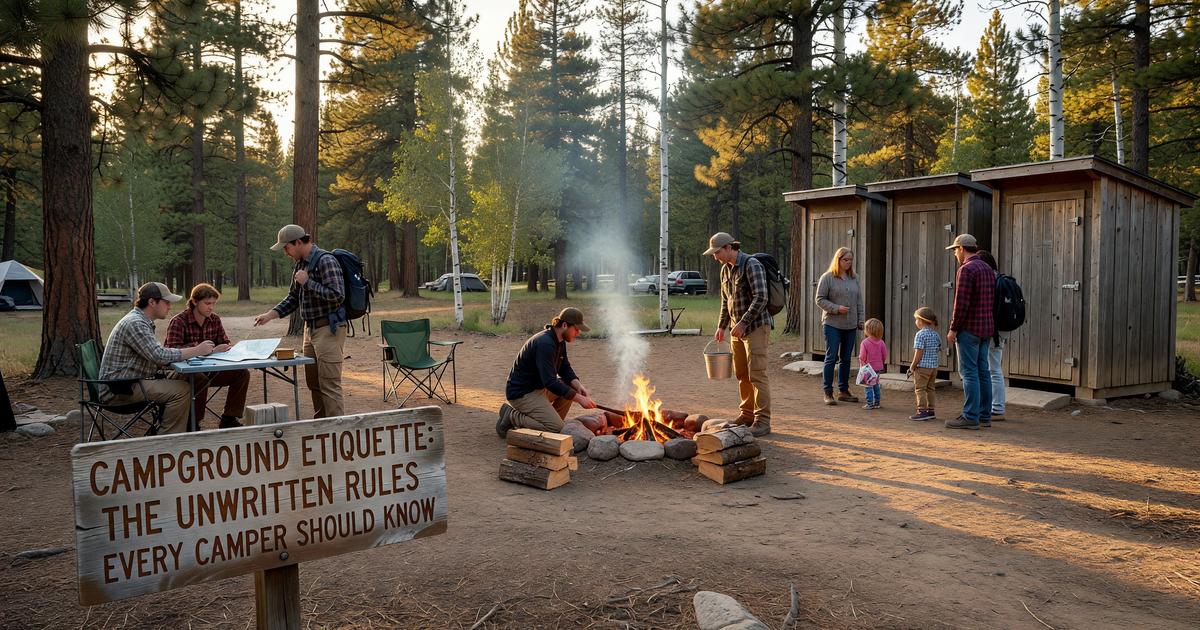
Nobody hands you a rulebook when you pull into a campground. The fee receipt covers check-in time and fire restrictions — it does not explain why the people in the next site are quietly furious with you by 11 PM on Friday night. Campground etiquette is a body of shared expectations that experienced campers carry with them and first-timers discover the hard way.
Most of it comes down to a simple principle: campgrounds compress people into small spaces. The site boundaries are close, the sounds carry, and the smells travel. Habits that are invisible in your backyard become very present for your neighbors.
Quiet Hours Are a Contract, Not a Suggestion
Most campgrounds post quiet hours — typically 10 PM to 6 or 7 AM. These are not aspirational. They represent an agreement that everyone camping there made when they checked in, and violating them affects the sleep, comfort, and experience of everyone within earshot.
Quiet hours mean voices at conversation level or below, not a crowd-level campfire gathering. They mean no generator operation, no power tools, and no amplified music. The sound of a generator at midnight carries several hundred feet across still air — experienced campers know exactly how far.
Quiet hours also govern arrival timing. If you are driving in after 10 PM, you have two obligations: warn the campground office in advance, and set up in near-darkness with minimum light and noise. Arriving late and illuminating an entire loop with headlights while unloading a truck is a fast way to alienate every neighbor before you meet them.
Respect the Site Boundaries
A campsite boundary is the boundary of your paid space — the pad, the table, the fire ring within the designated lines. It is not an approximate zone. Walking through a neighbor's site, cutting across to reach a trail, or allowing your children or dogs to treat adjacent sites as open territory is a campground etiquette failure that most people will not mention but will remember.
At crowded campgrounds, this applies particularly to the following:
Parking: Park in your designated pad, not on the grass, and not blocking the entrance to adjacent sites. At many state and national park campgrounds, each site has one or two marked parking spots. Stay within them.
Clotheslines and slack lines: Both require anchoring to trees. Check that neither encroaches on a neighbor's site or on a pathway. Many campgrounds have regulations on lines attached to trees — check the posted rules.
Shade: If you are setting up a large tarp or shelter, be conscious that it may cast shade onto a neighboring site. Not a prohibition, but worth awareness.
Campfire Protocol
Open campfires are the center of most campground experiences, and they come with etiquette dimensions that matter for safety as well as neighborliness.
Burn only what is permitted. Most campgrounds prohibit bringing in outside firewood to prevent the transport of invasive insects — emerald ash borer and spotted lanternfly spread largely through this vector. Buy firewood locally or at the campground store. The National Park Service's firewood guidelines are clear on why this matters, and many state regulations mirror them.
Extinguish completely. A fire that appears dead — no visible flame — can retain heat in the embers for hours. The standard rule is cold to the touch before you leave or sleep. Drown the fire with water, stir the ash, drown again. If you can hold your hand six inches above the fire ring and it is warm, it is not out.
Smoke direction. You cannot control smoke direction entirely, but you can control fire size. A smaller, hotter fire produces less smoke than a large, smoldering one. If your smoke is blowing consistently into a neighbor's site, a smaller fire and a wind-aware orientation of your sitting area can help.
Respect fire restrictions. During dry conditions, campgrounds may post fire bans — Stage 1 (no campfires, no charcoal, gas stoves permitted) or Stage 2 (no open flames at all). These are not optional and they are not interpretive. If you see a fire ban posted and someone is maintaining a campfire, tell the camp host.
Generator Use
Generators are broadly disliked at campgrounds and increasingly regulated. Many campgrounds restrict them to specific hours — typically 8 AM to 8 PM or similar — and prohibit them in loop areas near tent sites. Check the posted rules before running yours.
At campgrounds with electrical hookups, there is generally no reason to run a generator. If you are in a dry-camp area without hookups, consider a battery bank with solar as an alternative for most loads. A 100-watt solar panel and a 200Ah LiFePO4 battery can run a CPAP machine, charge devices, run a fan, and power LED lighting — without the noise and fumes.
If you do need to run a generator, face the exhaust away from neighboring sites, minimize runtime, and never run it inside an enclosed space.
Shared Facilities: Bathrooms and Dump Stations
The bathrooms in a campground are shared resources that everyone is using every morning. A few practices make them work better for everyone:
Leave them how you found them. Wipe down surfaces, dispose of waste properly, and do not leave personal items occupying limited counter or hook space for hours.
Time it. Shower use during peak morning hours (7–9 AM at most campgrounds) creates lines. Early or mid-morning showers avoid the competition.
Dump station protocol. At dump stations, back in efficiently, run your dump procedure without delay, flush the station inlet after you are done, and move on. The dump station is not a setup area for your sewer hose collection. Have your equipment staged before you pull up.
Pets
Dogs are welcome at most campgrounds with conditions attached. Those conditions are not suggestions.
Leash your dog. A leash requirement means on-leash at all times outside your site, not when your dog is friendly or small. Other campers may be afraid of dogs, may have dogs who are not friendly, or may simply prefer not to have an unknown animal approaching them. A leash requirement is the campground's attempt to manage all of those dynamics at once.
Clean up. Immediately, completely, in the provided waste bags or your own. Every campground that has to post "Pick Up After Your Pet" signs has posted them because people have not been doing it.
Noise. A dog that barks continuously affects the experience of every nearby camper. If your dog cannot be quiet in a campsite setting, address it before bringing them. A dog barking for an hour at 7 AM in a quiet campground is not endearing.
The Camp Host
Every campground with a camp host has a person — usually a volunteer or low-fee-site resident — whose role is to help the campground run smoothly and address rule violations. They are not law enforcement, but they can escalate to ranger staff, and they can ask you to leave.
If something is wrong at your site — a utility problem, a conflict with a neighbor, uncertainty about rules — the camp host is the right first call. They know the specific campground, its quirks, and its resources. Use them.
Frequently Asked Questions
What are standard quiet hours at campgrounds? Most campgrounds post quiet hours from 10 PM to 6 or 7 AM. During these hours, voices should be at conversation level, generators should be off, and no amplified music or loud activity. Quiet hours are a posted rule at most state and national park campgrounds and private RV parks alike.
Can I bring my own firewood to a campground? Many campgrounds prohibit bringing outside firewood due to the risk of transporting invasive insects like emerald ash borer and spotted lanternfly. Check the specific campground's rules before you arrive. Most campgrounds sell firewood on-site, and many state and national park campgrounds require that all firewood be purchased within a certain distance of the park.
What is the etiquette for walking through a campsite that is not yours? Do not walk through other campers' sites. Each site is paid space and the occupants have an expectation of privacy within those boundaries. Even if a site appears empty or the path looks like a shortcut, go around. This is one of the most commonly violated campground etiquette norms.
How do I properly extinguish a campfire? Pour water on the fire, stir the ash with a stick, then pour water again. Repeat until the ash is cold to the touch — you should be able to hold your hand six inches above the fire ring without feeling heat. Never leave a fire ring that appears extinguished but still feels warm. Drown it again before sleeping or leaving your site.
Are generators allowed at all campgrounds? Generator rules vary by campground. Many allow generators only during specific hours (often 8 AM to 8 PM or similar) and prohibit them in tent-only areas. Some campgrounds ban generators entirely. Check the specific campground's rules at check-in and on the posted campground map. At electric hookup sites, generators are generally unnecessary.
Further Reading from Authoritative Sources
- Leave No Trace Center for Outdoor Ethics — The seven LNT principles underpin most campground etiquette rules, covering campfire, waste, and impact minimization.
- National Park Service — Firewood and Invasive Species — NPS guidance on why firewood transport rules exist and how they protect forest ecosystems.