Campfire-caused wildfires are not a historical problem. In 2023, unattended or improperly extinguished campfires remained one of the leading human causes of wildland fire ignitions in the western United States. The stakes — in property, in land, in lives — are real. Understanding how fire safety rules work and how to follow them correctly is a core camping skill, not an optional add-on.
This guide covers the fire restriction system, how to build and manage a campfire safely, and what to do in campground scenarios where fire is either restricted or unavailable.
How Campground Fire Restrictions Work
Fire restrictions in the United States are managed at multiple levels — federal, state, county, and by individual land management agencies. The result is a system that can seem confusing but follows a logic.
The four-level restriction scale used by most western states and federal land management agencies:
No restrictions (Green): Open campfires permitted in designated fire rings. Normal campground rules apply.
Stage 1 restrictions: No campfires or charcoal fires outside of developed recreation sites with metal fire rings. Portable gas stoves with shut-off valves are permitted. Smoking only within an enclosed vehicle, building, or at a developed site.
Stage 2 restrictions: No campfires, charcoal grills, coal or wood fires of any kind. Gas and propane stoves with shut-off valves may still be permitted. This is effectively a complete fire ban for open flames.
Stage 3 / Emergency restrictions: Complete closure of all or specific forest areas. Not just fires — access itself may be restricted.
Campgrounds within a restriction zone must post current restriction levels at the entrance. If there is any doubt, call the managing ranger district or check the InciWeb National Interagency Fire Center or the specific national forest or BLM field office website before leaving home.
Critical point: Campgrounds within national forests or on BLM land fall under forest-wide or county restrictions, not just campground-level rules. A campground may have metal fire rings and appear set up for campfires, but if a Stage 2 restriction is in effect for the surrounding forest, campfires in those rings are prohibited. The ring being there does not mean use is authorized.
What "Developed Site" Means in Fire Restriction Language
Stage 1 restrictions often include the phrase "permitted in developed recreation sites with metal fire rings." This distinction matters.
A developed recreation site with a metal fire ring means a designated campground or day-use area with fire infrastructure maintained by the managing agency — a ground-mounted or above-ground metal ring or grate, typically in a concrete or rock collar. It does not mean a fire ring you build yourself from rocks, a portable fire pit, or a charcoal grill you bring from home.
Under Stage 1, most portable and charcoal fire options are prohibited even at campgrounds with designated fire rings, unless the specific restriction language explicitly permits them. When in doubt, call and ask.
Building a Campfire Safely
When campfires are permitted, these practices reduce risk for you and the surrounding land.
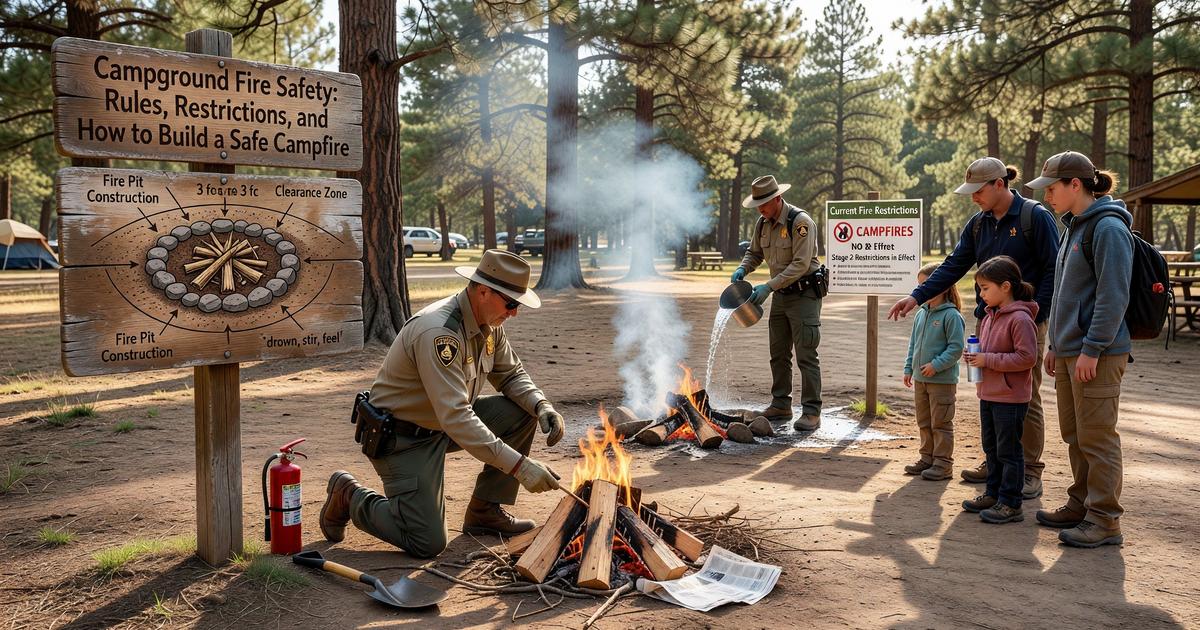
Use the established fire ring. Every designated campsite with fire infrastructure has a defined fire ring for a reason — cleared ground, defined boundaries, typically a metal container. Do not build a fire outside the designated ring. Never build a ground fire directly on soil or leaf litter in a campground, even in the absence of a ring.
Site selection for dispersed camping (where campfires are permitted). If you are building a fire at a dispersed camp outside a designated campground, select a mineral soil surface clear of vegetation, duff, and roots. Avoid sandy riverbanks where wind can carry embers. The fire should be downwind of your tent and any dry vegetation.
Size your fire appropriately. A fire that fits within the fire ring with space to spare is a manageable campfire. A fire that fills and exceeds the ring is not. Excessive fire size increases spark emission, is harder to extinguish fully, and creates heat that can damage the ring structure and surrounding soil.
Keep water accessible. Have a water source — a bucket, your water jug, a camp shower bladder — immediately at hand before you start a fire. Not near camp. At the fire.
Never leave a fire unattended. Wind conditions can shift. An ember that was fine three minutes ago can catch dry grass during a gust. At popular campgrounds with close site spacing, an escaped fire can reach neighboring sites quickly. The rule is simple: someone at the fire or the fire is out.
Extinguish completely. The standard is cold to the touch — not visually extinguished, not dwindled to coals, but physically cold enough that you can hold your hand in the ash. Procedure: pour water, stir with a stick, pour water again. Repeat until there is no steam and the ash is cold. This typically takes more water than you expect.
The National Park Service's campfire guidelines provide a consistent framework across park units and are worth reading before any camping trip involving fire.
Fire restrictions and extreme heat frequently coincide in desert and canyon country during peak summer — see our guide to heat safety at desert and canyon campgrounds if your trip involves both hazards.
Campfire Alternatives When Fire Bans Are Active
Stage 1 and Stage 2 fire restrictions do not mean no warmth and no cooking. They redirect campers to alternatives that carry significantly lower ignition risk.
Propane and isobutane camp stoves are permitted under Stage 1 and most Stage 2 restrictions, provided they have an on-off valve and shut-off valve. A two-burner propane camp stove handles all cooking needs. A canister stove (MSR PocketRocket, Jetboil) handles backpacking-scale cooking. These are not compromises — they are faster and more controllable than fire for most cooking tasks.
Propane fire rings and fire tables. These produce a genuine fire experience without the wood ember risk. Many campgrounds have begun installing permanent propane fire rings at sites. Personal portable propane fire pits are typically permitted under Stage 1 restrictions. Confirm with the specific campground — some prohibit all open-flame devices during restrictions regardless of fuel type.
Candles and headlamps provide light. Do not underestimate how much this matters psychologically when the campfire is off the table. A cluster of candles in a wind-protected lantern provides genuine warmth and light at the camp table.
Insulation instead of fire for warmth. This is the winter camping lesson applied to summer restriction periods: your sleeping system, your layers, and your tent are what keep you warm. A campfire is ambiance in July and a genuine warmth source in November. In summer restrictions, the ambiance is the main loss; plan your layering and tent setup accordingly.
Common Campfire Violations and Consequences
Campfire violations on federal land carry substantial penalties. Under the Code of Federal Regulations governing national forests and BLM land, violations during fire restrictions can result in fines up to $5,000 and up to six months imprisonment. Civil liability for the cost of wildfire suppression — which can reach tens of millions of dollars — is a separate legal exposure.
Common violations include:
- Starting a fire during a declared Stage 1 or Stage 2 restriction
- Leaving a campfire unattended
- Failing to fully extinguish before departure or sleeping
- Building a fire outside the designated fire ring
- Bringing prohibited firewood (invasive species transport regulations)
Forest rangers and camp hosts actively check campfires during restriction periods. The consequences for violations extend well beyond the immediate fine — the reputational and legal exposure for a fire that escapes is the real risk.
For campground-specific tips on etiquette around fires and generators, see our campground etiquette guide.
Frequently Asked Questions
How do I find out if there are fire restrictions at my campground? Check the managing agency's website before your trip — national forest ranger district sites and BLM field office sites post current fire restrictions. The National Interagency Fire Center (nifc.gov) maintains a national overview. Call the campground or ranger station directly if the website is not current.
Can I use a portable fire pit during fire restrictions? It depends on the restriction level. Under Stage 1, campfires in designated metal rings at developed campgrounds are typically permitted, but portable pits may be prohibited. Under Stage 2, most open-flame devices are banned. Confirm with the specific campground or ranger district.
What can I cook with during a campfire ban? Propane and isobutane camp stoves with shut-off valves are permitted under most Stage 1 and Stage 2 fire restrictions. A two-burner propane stove handles all cooking tasks. Charcoal grills are typically prohibited — gas is the compliant alternative.
How wet does a campfire need to be before it is considered extinguished? The standard is cold to the touch. Pour water, stir the ash, pour again. Repeat until no steam rises and the ash is physically cool. Never leave a fire ring that still feels warm.
What are the penalties for starting a campfire during a fire ban? On federal lands, violations can result in fines up to $5,000 and up to six months imprisonment. Civil liability for wildfire suppression costs is an additional exposure. State penalties are comparably serious in most western states.
Further Reading from Authoritative Sources
- National Park Service — Campfire Safety — NPS guidance on campfire building, management, and extinguishing procedures at developed campgrounds.
- NFPA — Outdoor Burning Safety — National Fire Protection Association guidance on outdoor fire safety and prevention.