Taking a dog camping sounds simple until you start filtering campgrounds and realize how widely the rules vary. Some campgrounds are genuinely pet-friendly — trails, dog swimming areas, good infrastructure. Others technically allow pets but post restrictions that effectively confine your dog to the campsite. A few prohibit pets entirely. Knowing which is which before you book saves significant frustration.
This guide covers how to evaluate campground pet policies, what to bring, how to manage a dog in the campground environment, and which campground types tend to be most accommodating.
How Pet Policies Vary by Campground Type
The variation in pet accommodation runs roughly along facility-type lines.
Private campgrounds (KOA, Jellystone, independent RV parks) are generally the most pet-permissive. Most allow dogs with a weight or breed restriction, require proof of vaccination on request, and charge a small per-night pet fee. Amenities specifically for dogs — a fenced dog park, a dog washing station — are increasingly common at mid-range and premium private parks.
State park campgrounds allow pets in most campground areas but often restrict them from day-use beaches, designated swim areas, and some trails. Leash rules are enforced seriously — rangers issue citations for off-leash dogs in state parks in a way that many private campgrounds do not. State park pet fees range from zero to $5/night in most systems.
National park campgrounds are the most restrictive. Dogs are permitted in most campground areas but barred from most trails, backcountry areas, and visitor facilities. The standard NPS rule: pets must be on a leash no longer than six feet, may not be left unattended, and are restricted to developed areas including campgrounds, parking lots, and paved roads. Dogs on national park trails are the exception rather than the rule — the NPS pet policy details the specific exceptions. If your camping goal is hiking with your dog, a national park campground may not serve that goal well.
National forest and BLM dispersed camping is generally the most flexible for dogs. Most national forest camping allows dogs on trails and in dispersed sites with minimal formal restrictions. The trade-off is reduced infrastructure — no hookups, fewer facilities, often no official campground at all. For dog-oriented camping, a dispersed camp in a national forest is often the best platform.
Evaluating a Campground's Pet Policy Before You Book
Before booking, look for explicit answers to four questions:
Are there breed or weight restrictions? Some campgrounds prohibit specific breeds (pit bull-type dogs, Rottweilers, German shepherds are commonly restricted). Others set weight limits (25 lbs, 50 lbs). Find out before you drive four hours.
How many pets are allowed per site? The standard is two per site. Some campgrounds limit to one; a few are flexible to three or more if you call ahead.
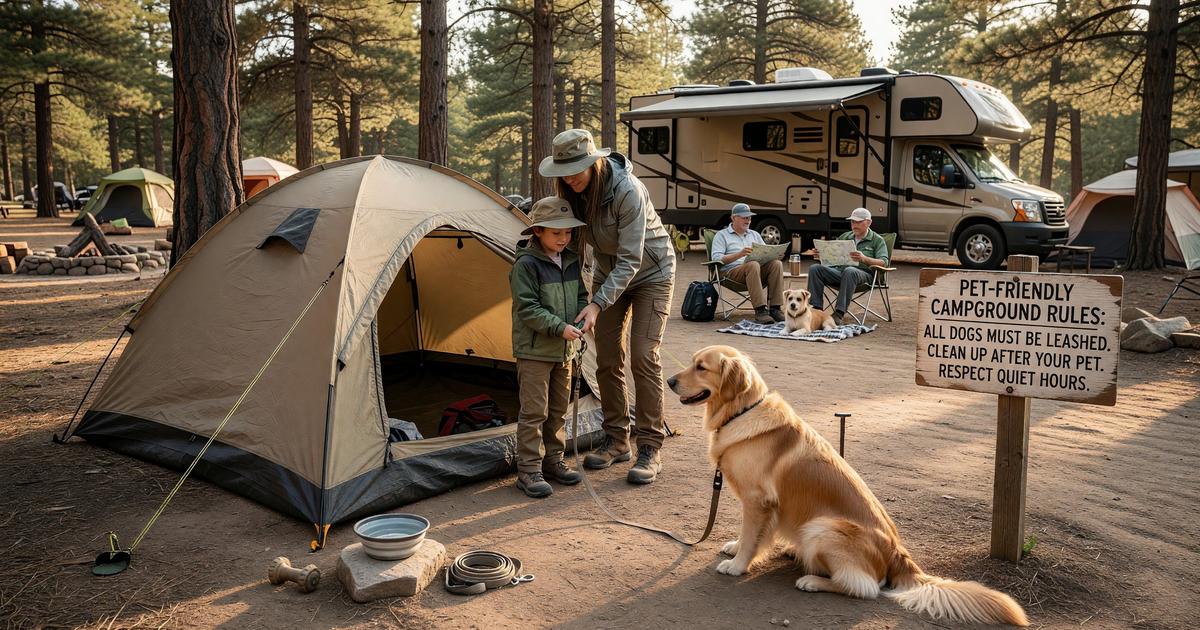
What are the leash requirements? Most require a leash at all times outside the site. Some require leashes even within the site boundary. Very few have off-leash designated areas.
Are pets allowed in the specific area you want to use? A campground may allow pets but restrict them from the lakefront, the playground, or certain trail sections. Read the fine print.
What to Pack for Camping with a Dog
Gear specific to dogs:
- Leash and collar with current ID tags. Bring a backup leash. Dogs break free in woods more often than in your backyard, and a lost dog in an unfamiliar forest is a serious situation.
- Current vaccination records. Not all campgrounds ask, but some do, and having them avoids problems.
- Long-line tether or stake. A 15-20 foot tether clipped to a screw-in stake ($12-20) allows your dog to move around the campsite without requiring you to hold the leash constantly. Do not substitute this for a leash on trails or in common areas.
- Food, water, and bowls. Collapsible silicone bowls are compact. Bring more food than you think you need — dogs burn more energy on camping trips.
- Poop bags, more than you expect to use. Pack them in every pocket, bag, and compartment.
- Tick prevention. Campgrounds in tick habitat — most wooded areas in the eastern US — require current tick prevention treatment and daily full-body checks on your dog. The CDC's tick prevention guidance applies to pets as well as humans.
- Dog first aid kit. Tweezers for ticks, bandage material for paw injuries, Benadryl dosage chart for allergic reactions, your veterinarian's emergency number.
- Dog bed or mat. Something that smells like home helps dogs settle in an unfamiliar environment, especially for the first night.
Camping comfort items that help dogs specifically:
A dog who has a clear "place" to settle — their mat at the campsite — is less anxious and less likely to wander or bark. Establish the mat as the designated rest spot from the first evening.
Managing Your Dog at the Campground
The most common problem with camping with dogs is not aggressive dogs or destructive dogs — it is vocal dogs. A dog that barks in response to camp sounds, other dogs, or unfamiliar nighttime noises affects the entire loop's experience.
If your dog tends to bark at strangers or react to other dogs, manage your campsite to minimize exposure: position your chair so the dog is not facing the main foot traffic path, use a wind-down routine at night, and consider a white noise speaker to muffle campground sounds during sleep hours.
Never leave your dog unattended at the campsite. Most campground rules explicitly prohibit this, for good reason — a dog tied to a tree and left alone may bark continuously, break free, or be frightened by wildlife. If you need to go somewhere your dog cannot accompany you, arrange alternative care or bring a travel partner who can stay with the dog.
Dog-Friendly Campground Picks by Region
Rather than a specific ranked list (which changes as campgrounds update their policies), here is a framework by region:
Southeast: State parks in the Carolinas, Georgia, and Tennessee tend to be more trail-accessible to dogs than national park options. Pisgah National Forest in North Carolina has extensive dog-friendly trails and dispersed camping options.
Southwest: National Forest camping around Flagstaff, Prescott, and Sedona (Arizona) allows dogs on most trails. BLM land in southern Utah is among the most dog-accommodating public land camping available, with minimal formal restrictions on the trail network.
Pacific Northwest: The Olympic and Gifford Pinchot National Forests have many dog-accessible trails alongside campgrounds. Mount Rainier and Olympic National Parks are more restrictive.
Northeast: State parks in Vermont, New York's Adirondacks, and Maine's Acadia-adjacent areas generally allow leashed dogs on most trails. Check individual state park trail rules before planning a hike-heavy trip.
Frequently Asked Questions
Are dogs allowed in national park campgrounds? Yes, dogs are permitted in most national park campground areas, parking lots, and paved roads. However, NPS rules prohibit dogs on most trails, in backcountry areas, and inside visitor facilities. Dogs must be on a leash no longer than six feet at all times and may not be left unattended. Check nps.gov for each park's current pet policy.
What campground types are most dog-friendly? Private campgrounds and national forest / BLM dispersed camping are generally the most accommodating for dogs. Private parks often have dedicated dog areas and fewer trail restrictions. National forest camping typically allows dogs on trails with minimal formal rules. National park campgrounds are the most restrictive, limiting dogs to developed areas.
Can I leave my dog unattended at a campsite? No — most campgrounds explicitly prohibit leaving dogs unattended at a campsite. An unattended dog may bark continuously, break free, or cause problems for neighboring campers. If you need to go somewhere your dog cannot accompany you, arrange for another person to stay at the site or make alternative care arrangements.
Do I need to show proof of vaccination for my dog at a campground? Not always, but some campgrounds require current rabies vaccination documentation. It is good practice to bring your dog's vaccination records on any camping trip. Many campgrounds that do not require them at check-in may ask to see them if there is a complaint or incident.
How do I prevent my dog from barking at other campers at night? Position your dog's sleeping area away from the direction of foot traffic or neighboring sites. Use a white noise speaker or fan to muffle unfamiliar campground sounds. Establish a clear wind-down routine in the evening. Dogs who have a specific rest spot — a familiar mat or bed — settle faster than dogs sleeping in unfamiliar configurations. Tire your dog out with a good hike before dark.
Further Reading from Authoritative Sources
- National Park Service — Pets in National Parks — Official NPS pet policy covering where pets are and are not permitted, and how the rules apply across different park areas.
- CDC — Tick Prevention — Prevention guidelines covering tick checks and treatment for both people and pets in wooded and grassy areas.