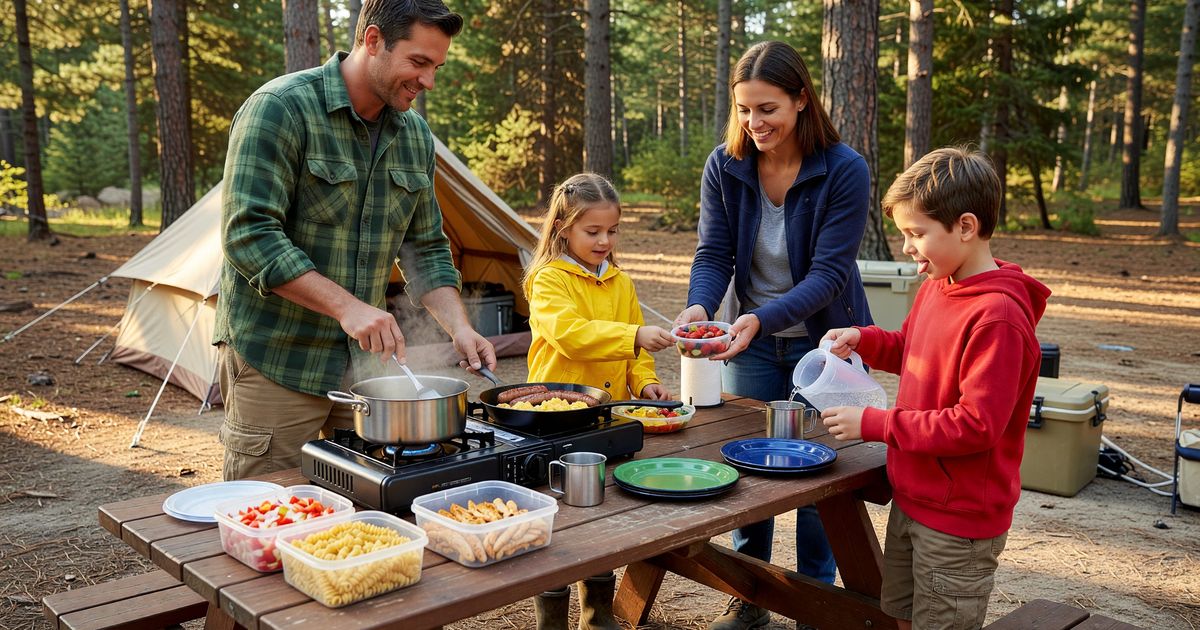
Camp cooking with kids is a logistics exercise as much as a culinary one. The ideal camping meal has three properties: it can be prepped substantially at home, it cooks quickly or requires minimal active attention, and it produces something that children who are tired and hungry will actually eat. Elaborate campfire recipes made from scratch require an investment of time and attention that a parent managing three kids at dusk at a campsite simply does not have.
The approach that works is simple: do the work at home, execute at camp. Every minute of prep you do in your actual kitchen is worth five minutes at the campsite.
The Home-Prep Strategy
Batch-cook proteins before leaving. Ground beef, chicken thighs, and Italian sausage can be cooked at home, cooled, and packed in zip-lock bags. At camp, they heat up in minutes on any stove or fire. Tacos, pasta sauce, fried rice, and quesadillas all work with pre-cooked protein.
Pre-measure dry ingredients. If you are making pancakes or a skillet breakfast, measure all the dry ingredients into a zip-lock bag at home. At camp, add wet ingredients and cook. This eliminates measurement steps when you are working without a counter, without good light, and with impatient children.
Marinate proteins in bags. Chicken, pork chops, or shrimp marinated and packed in a zip-lock bag goes directly from the cooler to the grill or pan. No additional prep at camp.
Pre-chop vegetables. Everything that needs chopping (onions, peppers, garlic, zucchini) gets chopped at home and packed in containers or bags. Chopping at a campsite picnic table without a proper cutting surface is slow and difficult.
Breakfast
Campfire Breakfast Burritos (Prep-Ahead)
Pre-make scrambled eggs with vegetables and sausage at home. Pack in a zip-lock with shredded cheese. At camp: warm tortillas in a dry pan, heat the egg mixture, assemble. Total camp time: 10 minutes.
For cooking at the fire: wrap assembled burritos in foil and warm on the fire grate for 5-7 minutes per side.
Dutch Oven Blueberry Pancakes
Pancake mix (pre-measured dry ingredients in a bag), eggs, oil, and fresh or frozen blueberries. Mix at camp. Cook on a griddle or pan. Holds well for a crowd; a Dutch oven or large pan lets you cook multiple pancakes at once. For kids who want to participate, this is a high-engagement cooking activity.
Egg Muffins (Make Ahead)
Beat 12 eggs with vegetables, cheese, and diced meat. Pour into a greased muffin tin and bake at home. Cool, bag, and refrigerate. At camp: warm in foil over the fire or on a pan. These travel exceptionally well and require zero camp prep beyond heating.
Lunch
Lunch at a campsite is usually informal and easy — a proper cooked lunch works only if the group has no afternoon activity planned and is genuinely willing to sit down for it. Realistically, plan for lunch to be assembled rather than cooked.
Wraps and sandwiches: Pre-made at camp from ingredients from the cooler. Deli meat, cheese, avocado, hummus, and vegetables assembled at the picnic table. No cooking, minimal cleanup.
Charcuterie-style camp lunch: A cutting board of cured meats, cheese, crackers, grapes, and nuts. Requires nothing cooked and is genuinely good. Kids who are picky at the dinner table often eat well from a variety board.
Campfire grilled cheese: Two slices of bread, butter, cheese, assembled and cooked in a pan or directly on the grate in a camp pie iron. Kids can manage the pie iron themselves (with supervision) and grilled cheese made with a pie iron over a fire consistently delights children in a way that pan grilled cheese does not.
Dinner
Dinner is where cooking investment pays off most — a good dinner establishes the campfire as the social center of the evening, and the food quality affects the whole group's mood in ways that breakfast and lunch do not.
Foil Packet Dinners
Foil packets are the quintessential campfire meal because they require minimal cleanup, cook reliably without much attention, and can be customized per family member.
Basic protein-vegetable packet: Protein (chicken breast or thighs, salmon, shrimp, Italian sausage sliced), vegetables (potatoes quartered, onion, bell pepper, zucchini), seasoning (salt, pepper, garlic powder, Italian herbs or fajita spice), and butter or olive oil. Assemble in double-layer heavy foil, crimp edges tightly, cook on hot coals or grate 20-30 minutes (chicken) or 15-20 minutes (seafood), flip once.
The important rule: Proteins must be fully cooked internally regardless of how good the outside looks. A food thermometer is useful — 165°F for chicken, 145°F for pork and fish. Pack a simple instant-read thermometer for this.
Pre-assemble at home. Put ingredients together in foil packets at home, refrigerate, and bring in the cooler. At camp, the packets go directly onto the coals. This eliminates all prep time.
One-Pot Pasta
Bring dried pasta, jarred sauce, pre-cooked ground beef or sausage (from home), and a large pot. Boil pasta in the pot with water. Drain. Add sauce and meat. Stir and heat through. Total time: 15-20 minutes. Serves a crowd, cleanup is one pot.
For a no-drain version: pasta, sauce, and enough water to cover, all in one pot, with a lid. Stir periodically. Cook until pasta is done and liquid is mostly absorbed. Less fussy than draining at a campsite.
Campfire Chili
Pre-made chili from home (cook a large batch, pack in a sealed container) heated in a pot. Serve with cornbread made in a Dutch oven or pre-made from home. Chili is ideal campfire food: it holds well in a cooler for two to three days, it heats in under 10 minutes, and it scales to any group size.
S'mores and Campfire Desserts
The s'more requires three components: graham crackers, chocolate, and marshmallows. On these, there is no substitute. The specific chocolate matters — a Hershey's milk chocolate bar is the traditional choice; alternatives are available but the s'more's emotional significance is linked to the specific form.
For a variation that children consider superior: Reese's Peanut Butter Cups in place of the chocolate square. This is universally preferred by the under-12 demographic.
Campfire banana boats: Slice a banana lengthwise through the peel, not all the way through. Stuff with chocolate chips and mini marshmallows. Wrap in foil. Cook on coals 5-7 minutes until chocolate is melted and marshmallows are soft. Eat with a spoon directly from the peel.
Camp Kitchen Management
Dish organization: A collapsible basin for washing, a second for rinsing. One person washes while another dries and puts away. Do dishes immediately after meals — food dried onto camp cookware in the sun is significantly harder to clean.
Bear and wildlife: Food and garbage stored correctly — in a bear box, in your locked vehicle, or hung from a tree — is both a campground rule at many locations and a genuine safety consideration. See the National Park Service food storage guidelines for standards that apply in bear habitat. Never leave food out unattended at a campsite.
Cooler management: Meat and dairy in the bottom cooler, drinks and less critical items in a second cooler if available. Minimize how often you open the cooler. Block ice in the bottom, cubed ice on top of food for accessibility.
For campground selection that supports good family cooking, see our family-friendly campground guide.
Frequently Asked Questions
What are the easiest camping meals for families? Foil packet dinners, one-pot pasta, pre-made chili heated on-site, and pre-cooked protein in tacos or burritos are among the most reliable options. The key is substantial prep done at home before leaving.
Can I cook campfire food without a fire? Yes. A two-burner propane camp stove handles virtually everything a campfire does for cooking. Foil packets can be cooked on a camp grill or in a covered pot. The campfire atmosphere is lost but the food quality is the same.
How do I keep food cold while camping? Pre-chill your cooler before loading. Use block ice in the bottom, pack food tightly, and keep the cooler out of direct sun. Minimize how often you open the lid.
How do I wash dishes while camping? Use a collapsible basin with heated water and camp dish soap. Scrape food scraps into the trash first. Dispose of wash water in the campground's designated grey water drain or scatter at least 200 feet from water sources.
Do I need a Dutch oven for camping? No — not for a first or casual trip. A standard camp pot and pan cover all basic cooking needs. A Dutch oven is a worthwhile upgrade for regular campers who enjoy more involved cooking.
Further Reading from Authoritative Sources
- National Park Service — Food Storage Requirements — NPS standards for campground food storage in bear habitat, applicable to most western and many eastern national park campgrounds.
- CDC — Food Safety Outdoors — Safe food handling and temperature guidelines for outdoor cooking and cooler storage.