Camping is among the safest family activities by measurable risk. The accidents that do happen at campgrounds — drowning, burns, lost children, heat illness — are preventable with specific practices. This guide addresses the actual risks in order of consequence, not in order of how scary they sound.
Water Safety at Campground Swimming Areas
Drowning is the leading cause of accidental death for children ages 1-4 in the United States and remains a significant risk through age 14. Campground lakes and rivers present specific challenges that backyard pools do not: uneven bottom terrain, varying water depth, current in river settings, reduced visibility in natural water, and absent or part-time lifeguard coverage.
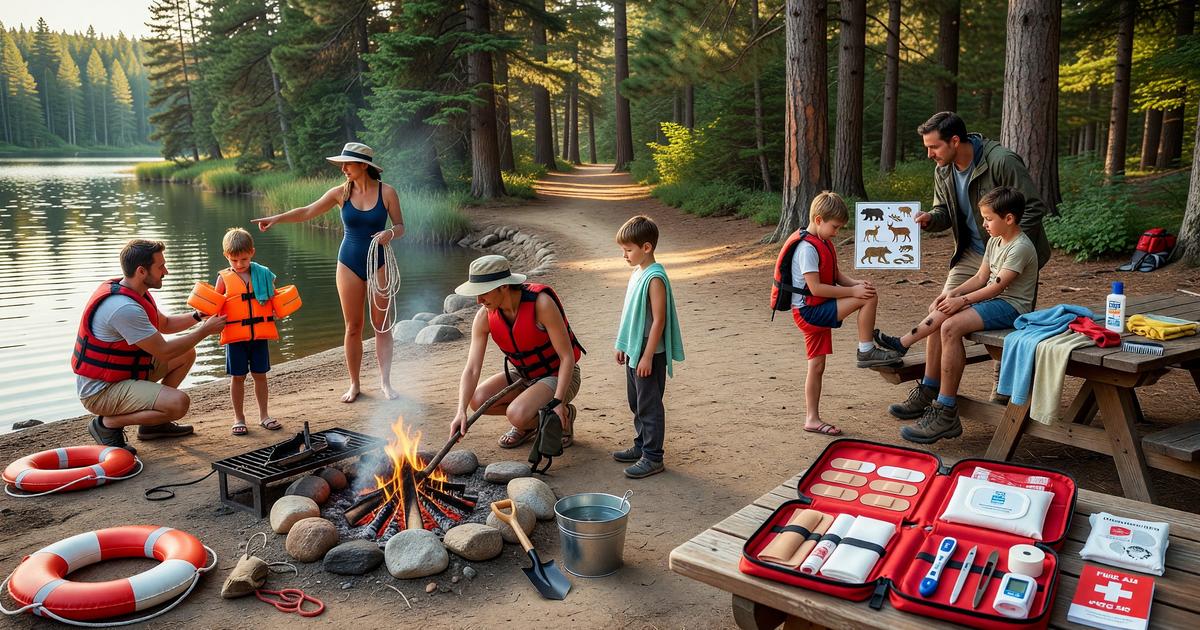
The supervision rule that actually works. The American Red Cross advocates for a designated "water watcher" — one adult whose sole responsibility during a swim is to watch the children in the water, without a phone, without a conversation, without any other distraction. When the water watcher needs to rotate off, a new watcher is named explicitly before anyone relaxes attention. This is not overcaution — the drowning incidents that happen at supervised locations consistently involve a momentary division of adult attention.
Lifeguard coverage at campgrounds. Many campground swim areas are not lifeguard-supervised, or are supervised only during peak hours. Know before you let children enter the water whether a trained lifeguard is present. If not, the water watcher requirement from above applies with full rigor.
Personal flotation devices (PFDs). The U.S. Coast Guard requires an appropriately-sized, Coast Guard-approved PFD for every person aboard a watercraft. For young children and weak swimmers in natural water, wearing a PFD in the water itself is the correct practice regardless of whether one is technically required. Coast Guard-approved Type III life jackets for children provide genuine protection; swim vests and puddle jumpers marketed for pool use are not the same thing and do not meet the same standard.
Natural water hazards. Brief children on the specific water before they enter: where the bottom drops off, whether there is current, where the edge of the swim zone is. Children who know the boundaries are less likely to wander into deeper or faster water.
Campfire Safety with Children
Burns are one of the most common campground injuries affecting children. Campfire burns tend to be more severe than minor burns from cooking at home because campfires are hotter, more accessible, and more entrancing.
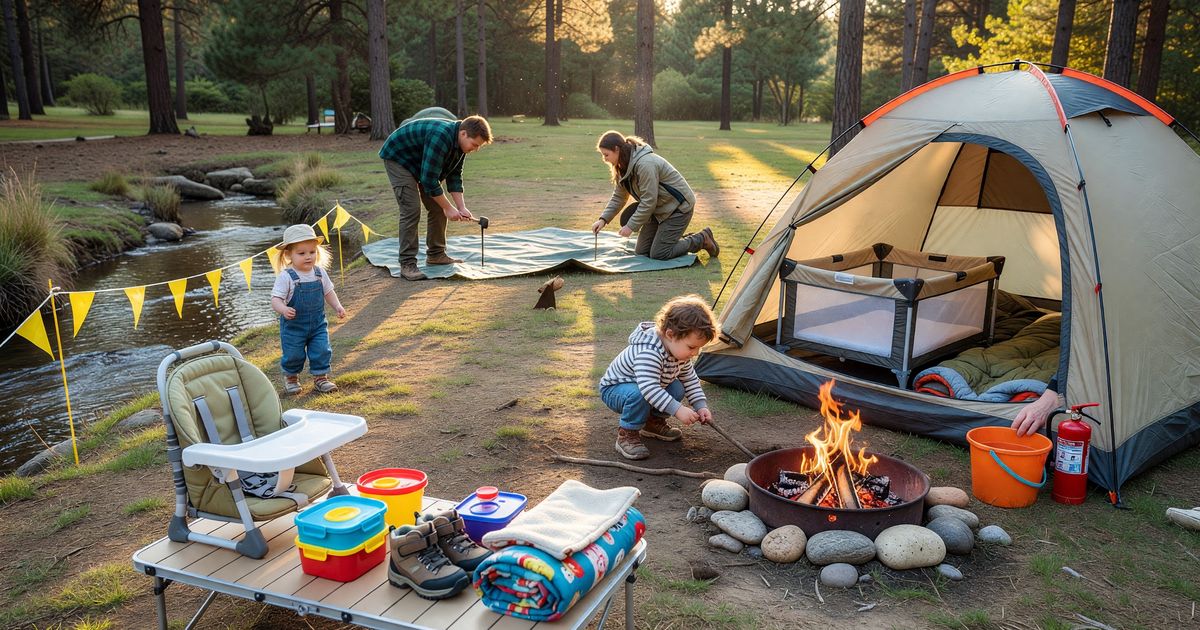
The fire circle rule. Establish a clear boundary around the fire ring — approximately three feet in all directions — that children understand as a no-cross line when the fire is burning. Some families use a physical marker (a ring of rocks, a rope perimeter). The clearer and more consistent the rule, the more reliably young children follow it.
Prohibit running near fire. Running near a campfire and tripping is the injury vector. No running in the fire circle radius is a simple rule that eliminates this mechanism.
Designated stick lengths. Marshmallow roasting with sticks is a camping tradition. Use sticks long enough (at least 3 feet) that children's hands are well away from the heat. Telescoping metal roasting sticks are a safe alternative to improvised sticks.
Fire extinguishing that children understand. Teach children the extinguishing procedure: water, stir, more water, check. Children who understand that their job is to help make the fire fully out — cold to the touch — are active participants in safety rather than bystanders.
NFPA guidance on campfire safety from the National Fire Protection Association recommends maintaining a clearance of 15 feet from structures and combustibles in all directions, burning only dry wood, and never leaving a fire unattended. See NFPA's fire pit guidelines for the full framework.
Wildlife Safety
Most campground wildlife encounters are benign — squirrels, deer, birds. The encounters worth preparing for are bears in bear-country campgrounds, and venomous snakes and insects in relevant regions.
Bear country basics. In national parks and many western campgrounds, bears are present and aware of campground food sources. The rules are straightforward and consistent:
- Store all food, scented items (toothpaste, sunscreen, trash), and coolers in a bear box or your locked vehicle when not actively in use
- Never leave food out at a campsite unattended, even briefly
- Do not bring food into the tent
- If a bear approaches the campsite, make noise, stand together as a group, and move toward a car or building — do not run
The NPS bear safety guidance covers specific response protocols and the difference between black bear and grizzly bear defensive responses.
Snakes. Most snakes in North America are non-venomous and avoid human contact. The practical rule: look before you step (especially near rocks, logs, and brush piles), wear closed-toe shoes on trails, and teach children not to reach into places they cannot see. If a family member is bitten by an unknown snake, immobilize the affected limb, keep it below heart level, and seek emergency care immediately. Do not attempt to catch or kill the snake.
Insects and stinging pests. Bee and wasp stings are common at campgrounds. For children with known allergies, an epinephrine auto-injector (EpiPen or equivalent) should be accessible at all times — in your camp bag, not in the car. For undiagnosed potential allergies, know the signs of anaphylaxis (difficulty breathing, swelling beyond the sting site, rapid pulse, confusion) and call 911 immediately if symptoms appear.
Tick prevention. In tick-prevalent areas — which includes most wooded and grassy campground environments east of the Rockies and many in the West — use DEET-based repellent on exposed skin and clothing. Perform full-body tick checks on all family members at the end of each day, paying particular attention to the scalp, behind the ears, armpits, and groin. The CDC's tick guidance specifies that attached ticks should be removed with fine-tipped tweezers, grasping close to the skin and pulling steadily upward. Do not apply heat or petroleum to the tick.
Heat and Sun Safety
Camping in warm weather involves extended sun exposure, physical activity, and limited shade. Heat exhaustion and sunburn are genuinely common campground health issues for families.
Hydration. Children need more reminders to drink than adults. Establish a hydration routine: water before, during, and after any physical activity; water with every meal; water before bed. The goal is regular intake before thirst develops, not drinking in response to thirst.
Sunscreen. Apply 30 minutes before sun exposure and reapply every 2 hours during activity. Water and sweat reduce effectiveness faster than expected. A hat that covers ears is a supplement, not a substitute.
Heat exhaustion signs in children: excessive sweating, weakness, pale or cool skin, nausea, headache, dizziness. Treatment: move to shade, cool the child (wet cloth on the neck, wrists, and armpits), provide cool water to drink. Heat exhaustion that is not treated can progress to heat stroke — if the child loses consciousness, stops sweating, or becomes confused, call 911.
If your trip involves a desert or canyon destination — where terrain and elevation can make heat far more severe than a typical campground — see our guide to heat safety at desert and canyon campgrounds for the additional precautions those environments require.
The Family Camp First Aid Kit
A standard kit plus additions for family camping:
- Bandages in multiple sizes
- Antiseptic wipes and antibiotic ointment
- Medical tape and gauze pads
- Moleskin (for blisters)
- Fine-tipped tweezers (tick removal and splinters)
- Instant cold pack
- Children's pain reliever / fever reducer (appropriate for ages present)
- Antihistamine (adult and children's dose)
- Epinephrine auto-injector if prescribed
- Emergency contact list including nearest hospital and poison control (1-800-222-1222)
- Thermometer
For what to pack for kids at camp more generally, see our guide to campground activities for kids.
Frequently Asked Questions
What is the biggest safety risk for children at campgrounds? Drowning in campground swimming areas is the highest-consequence risk for young children. A designated water watcher — one adult solely watching children in the water, with no other distractions — significantly reduces this risk. Burns and heat illness follow.
What should I do if a bear approaches my campsite? Stand your ground, group together to look large, and make noise. Do not run. Move toward a car or building if accessible. Never leave food out unattended — prevention is far better than any encounter.
How do I remove a tick from a child? Use fine-tipped tweezers, grasp close to the skin, and pull upward steadily. Do not twist or apply heat or petroleum jelly. Clean the bite with rubbing alcohol. Monitor for rash or fever in the following 3-30 days.
What are the signs of heat exhaustion in children? Heavy sweating, weakness or dizziness, pale or cool skin, nausea, and headache. Move to shade, apply cool wet cloths, provide cool water. If the child loses consciousness or stops sweating, call 911 — these indicate heat stroke.
Do I need a life jacket for my child at a campground swimming area? For children who are not strong swimmers, a Coast Guard-approved Type III life jacket worn in natural water is the recommended practice, especially when lifeguards are not present. Pool-style floaties do not meet Coast Guard standards.
Further Reading from Authoritative Sources
- CDC — Tick Bite Prevention and Removal — Specific procedures for tick prevention, repellent selection, and correct tick removal from the Centers for Disease Control.
- National Park Service — Bear Safety — NPS guidance on bear-country food storage, campsite behavior, and response during a bear encounter.