Backing a travel trailer into a campsite is the skill that causes more stress for new RV campers than any other. The mechanics are genuinely counterintuitive — the trailer turns opposite to what your instinct says — and doing it in a tight campground loop with an audience is genuinely intimidating until you have done it enough times to stop thinking about it.
The good news: it is a learnable skill with a specific technique that works, and practicing it in an empty parking lot before you arrive at a campground eliminates most of the stress.
Why Trailers Back Opposite to What You Expect
The steering confusion comes from the lever principle. When you turn your tow vehicle's rear left, the trailer's rear goes right. When you turn your tow vehicle's rear right, the trailer's rear goes left. The hitch point is the pivot, and the trailer and vehicle move as opposing arms of a lever.
The practical fix: when you want the trailer to go left, turn the steering wheel left (which sends the bottom of the wheel left and the tow vehicle's rear right, which pushes the trailer left). Some drivers find it easier to think of it as the bottom of the steering wheel pointing the direction the trailer goes.
This is counterintuitive enough that most new RV owners need to practice it before it becomes automatic. Practice in an empty parking lot with cones or cardboard boxes as stand-ins for trees and obstacles. Seriously. Ten minutes of empty-lot practice is worth more than four YouTube videos.
Motorhome Backing vs. Travel Trailer Backing
Backing a Class A, B, or C motorhome is simpler than backing a trailer because the unit is all one piece — it backs like a long vehicle, not a two-lever system. The challenge is purely the size and the limited rear visibility.
For motorhomes: Rely on mirrors adjusted for maximum rearward view, a rear-mounted backup camera (standard on most newer motorhomes), and a spotter. The technique is the same as backing any large vehicle — slow and incremental, using mirrors more than the camera for situational awareness.
For travel trailers and fifth wheels: The lever dynamic applies, plus the trailer's rear often extends well beyond the driver's mirror sightlines. A spotter is more important and backup cameras are less useful without a wide-angle view. Fifth wheels are somewhat more predictable than conventional trailers because the higher hitch point creates a more stable lever geometry.
The Full Step-by-Step for Trailer Backing
Before You Start
Walk the site before you back in. Every campsite has specific obstacles — trees, utility pedestals, the picnic table, the neighbor's awning, the fire ring. Walk the full arc your trailer needs to travel and identify the constraints. Know where you are going before you get in the truck.
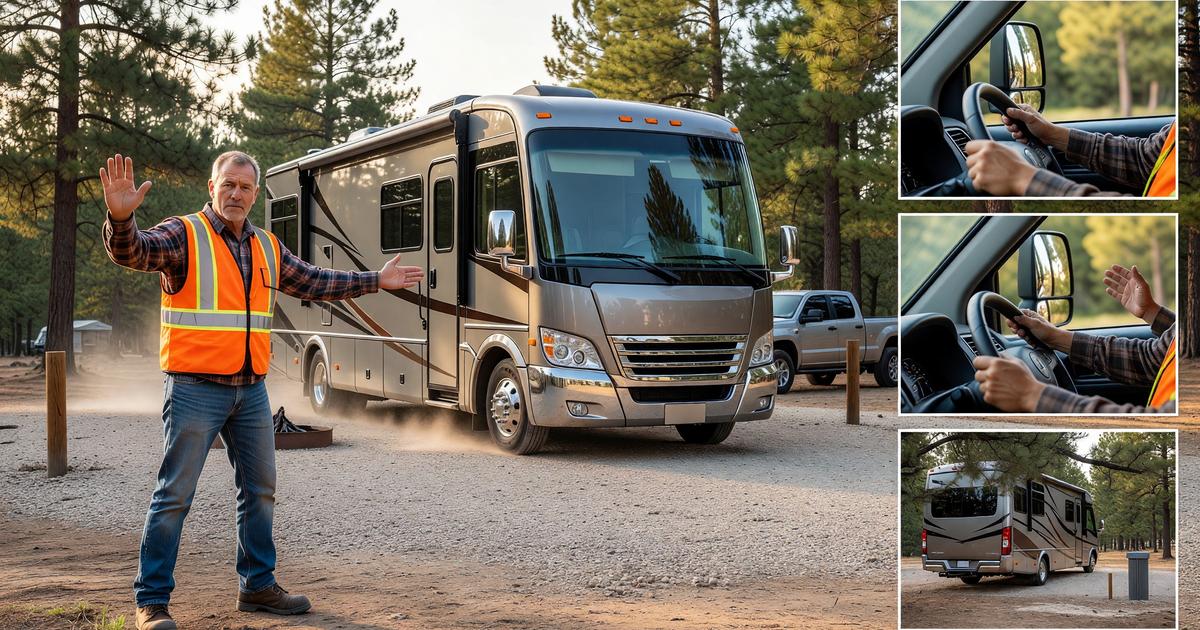
Assign a spotter. The spotter's job is to be your eyes for the rear of the trailer and the sides. Establish hand signals before you start: left hand raised means turn left, right hand raised means turn right, both hands raised means stop, thumbs down means the approach is off and you need to pull out and try again. Never rely on voice communication during backing — it is too unreliable.
Spotter position: The spotter stands in a position where they can see both the rear of the trailer AND the driver in the mirror. They should never stand directly behind the trailer. To the driver's left (driver's side of the vehicle) at a 45-degree angle from the rear of the trailer is typically the best position — visible to the driver via the left mirror, with a clear view of the trailer's rear clearances.
The Backing Sequence
1. Pull past the site entrance. Pull your tow vehicle far enough forward that you can begin a wide backing arc. The further forward you start, the wider the arc, and the more correction room you have. A common mistake is starting the backing approach too close to the site, which requires a sharp angle and leaves little room for error.
2. Begin the arc slowly. Use slow steering inputs. Backing with a trailer rewards small steering corrections, not large movements. Large corrections in one direction typically require a counter-correction that amplifies into a jack-knife or a loss of control of the trailer direction.
3. Watch the trailer in the left mirror. The left mirror shows the rear-left corner of the trailer. Use this as your primary reference for how the trailer is tracking relative to the site. The trailer's near side (the side toward you in the mirror) is what you can monitor most reliably.
4. Accept early corrections. If the trailer starts going wrong early — moving toward an obstacle before you have reached the site entrance — pull out and start again. Do not try to correct a seriously wrong approach through increasingly aggressive steering. The cleanest technique is to pull forward out of the approach entirely and restart with a better angle.
5. Slow to near-stop as you approach obstacles. Within ten feet of any obstacle — trees, the pedestal, the neighbor's awning — slow to walking pace or stop. Make adjustments from near-stopped, not from moving speed.
6. Have the spotter call the final distances. In the last five to ten feet, the spotter calls out distances: "six feet," "four feet," "two feet," "stop." Trust the spotter for distances you cannot see in the mirrors.
Common Mistakes and How to Avoid Them
Rushing. Backing a trailer slowly is much easier than backing quickly. Speed amplifies errors and gives less time to perceive and react to problems. If another camper is waiting for your site, signal that you know they are there and proceed at your pace. They will wait.
Over-correcting. Small, steady steering inputs. If you correct past center and the trailer starts going the other direction, you are in a sawing pattern that gets worse. A series of small corrections is always better than one large one.
Starting at the wrong angle. If your initial pull-forward did not put the truck at a favorable angle for the backing arc, pull all the way out and reposition rather than fighting a bad angle. Two clean attempts are faster than one long struggling attempt.
No spotter. Some experienced RV campers can back into open sites solo using a combination of mirrors and cameras. In tight, obstacle-rich campground loops, a spotter is not optional for most people. If you are traveling solo, some campgrounds have staff who will spot for you — ask at check-in. Many neighbors will volunteer.
Jackknife awareness. The maximum angle between tow vehicle and trailer before the trailer starts pushing against the rear corner of the tow vehicle is roughly 90 degrees (varies by hitch configuration). If you feel or hear the trailer making contact with the truck, stop and pull forward immediately — the trailer cannot articulate further in that direction without damage.
See our complete guide to RV hookups for what to do once you are in the site and ready to connect utilities.
Frequently Asked Questions
Why does a travel trailer back opposite to what I expect? The hitch point acts as a pivot. When the tow vehicle's rear moves left, the trailer's rear moves right. To send the trailer left, turn your steering wheel left. Many drivers find it helpful to think of the bottom of the steering wheel pointing in the direction they want the trailer to go.
Should I use a spotter when backing an RV into a campsite? Yes. The spotter stands at a 45-degree angle from the trailer's rear on the driver's side, visible in the left mirror. Establish hand signals before beginning — raised hands for direction, both hands raised for stop. Never rely on voice communication during backing.
How do I practice backing a travel trailer? Practice in an empty parking lot before your first campground. Set up cardboard boxes or cones to simulate a campsite entry. Ten to twenty minutes of parking-lot practice translates directly to campground performance.
What is jackknifing and how do I prevent it? Jackknifing occurs when the angle between tow vehicle and trailer exceeds the hitch's maximum articulation, causing the trailer to contact the rear corner of the tow vehicle. Stop and pull forward before reaching this limit. If you feel resistance or hear contact, stop immediately.
Is backing a motorhome different from backing a travel trailer? Yes. A motorhome backs as a single unit with no lever dynamic. The challenge is purely size and visibility. Use mirrors and backup camera, and rely on a spotter for final close-quarters positioning.
Further Reading from Authoritative Sources
- RVIA — RV Driving and Towing Safety — Industry guidance on RV operation, including towing and maneuvering safety.
- Go RVing — RV Driving Guide — Practical driving and maneuvering guidance for new RV owners including backing and campsite approach techniques.