No part of RV ownership generates more questions, more contradictory advice, and more avoidable problems than holding tank maintenance. The black tank in particular is a source of ongoing difficulty for RV campers who were not given a proper orientation when they bought their rig — and most are not.
The problems are preventable. The solutions are consistent and not complex. What follows is a practical guide to maintaining both tanks based on how the systems actually work.
How the Holding Tank System Works
Your RV has a minimum of two holding tanks: a grey water tank (collecting wastewater from sinks and the shower) and a black water tank (collecting toilet waste). Many RVs have additional tanks — a second grey tank for one of the sinks, or a separate holding area for the kitchen sink.
Both tanks have sensor probes mounted through the tank walls at multiple levels (empty, 1/3, 2/3, full). Both drain through 3-inch termination valves at the undercarriage. The black tank typically has a 3-inch valve; grey tanks may share or have individual valves.
At a full-hookup campground site, both tanks connect through sewer hose to the campground's sewer system. At non-hookup sites, you manage tanks until they fill, then dump at a dump station. For the dump station process and sewer hose setup, see our complete guide to RV hookups.
The Pyramid Plug: What It Is and How to Prevent It
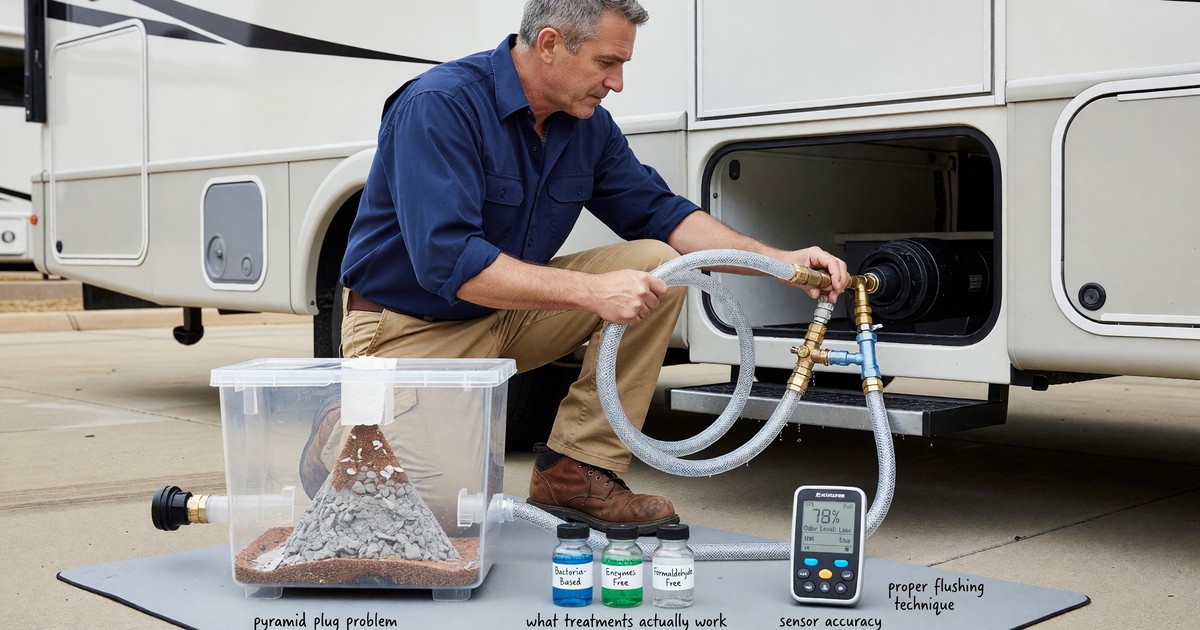
The pyramid plug — also called the poop pyramid — is the most commonly discussed black tank problem and also the most preventable. It forms when the black tank drain valve is left open permanently while connected to a sewer hookup, allowing liquid to drain continuously while solid waste accumulates at the bottom of the tank.
The result is a cone-shaped mound of solid waste that dries, hardens, and eventually blocks the drain opening entirely. By the time you discover it, the cone may be substantial — difficult and unpleasant to break up.
Prevention is simple: Never leave the black tank valve open. Always allow the black tank to fill to at least two-thirds capacity before draining. The liquid volume in the tank, when you open the valve, is what produces the velocity to flush solids through the drain and into the sewer connection. A nearly-full tank draining completely flushes effectively. A continuous-drain situation never generates enough flow to do this.
At a multi-week hookup site, this means you dump the black tank every 5-7 days depending on use, not continuously. The grey tank can be left partially open (or fully open, for continuous drain) without the same risk because grey tank waste does not produce solids that accumulate.
Treatment after formation: If you already have a partial pyramid, do not attempt to break it up by running the toilet. Instead: close all valves, fill the black tank with a large volume of water (partially fill through the toilet), add a tank treatment product designed for pyramid dissolution (enzyme-heavy treatments, or simple dish soap in significant volume), and drive on a highway for 30-60 minutes. The sloshing movement breaks up soft accumulation. Drain and repeat.
For severe hardened buildup, a plumber's bladder on a hose inserted through the toilet can be used to spray high-pressure water into the tank while it is partially full. This is unpleasant work but effective.
Sensor Accuracy Problems and Solutions
The level sensors in RV holding tanks are notoriously inaccurate, particularly in black tanks. The probes are exposed to waste, and a coating of solid waste, toilet paper, or scale on the probe tip causes false "full" readings even when the tank has capacity remaining.
Prevention: The sensors read full when their probe tips are coated. Keeping the tank properly maintained — correct liquid levels, enzyme treatments, good flushing — keeps the probes cleaner.
The tank flush system: Many newer RVs have a built-in tank rinse system — a small nozzle inside the black tank connected to a city water inlet. Running the flush rinser while draining sprays water inside the tank to rinse walls and probe tips. If your RV has this, use it every time you dump.
DIY probe cleaning: A product called Sensor Kleen (or similar enzyme-based probe treatments) is specifically formulated to clean sensor probes. Add it through the toilet before a long drive to let movement distribute the treatment across the probe tips.
The ice cube trick: Pour a large bag of ice into the black tank through the toilet, add water to partially fill, then drive 20-30 minutes. The ice tumbles around the interior, physically scrubbing probe tips and tank walls. Drain completely. This is a legitimate maintenance technique that many experienced RV owners use quarterly.
Holding Tank Treatments: What Actually Works
The holding tank treatment aisle at any RV supply store has dozens of products. Most fall into two categories:
Enzyme-based treatments: Use naturally occurring bacteria and enzymes to break down solid waste and tissue. These are the preferred option — they actually solve the problem by accelerating waste decomposition, they do not harm tank components, and they are legal at virtually all campgrounds and dump stations. Look for products with active enzyme strains listed on the label.
Formaldehyde-based treatments (traditional pink and blue fluids): These are the older product category. Formaldehyde chemically preserves and masks waste rather than breaking it down. They are effective at odor control in the short term but are prohibited at some campgrounds, can harm septic systems, and leave behind unbroken-down waste that contributes to long-term buildup. They are increasingly avoided by experienced RVers and restricted by some state and local regulations.
Detergent-based products: Dish soap, Dawn specifically, has a legitimate history of use in black tank maintenance. Added in quantity (4-8 oz), it lubricates the tank walls, helps prevent buildup, and has some surfactant action that aids waste breakdown. Not a primary treatment but a reasonable supplement.
Borax: A traditional home remedy — 1 cup borax added to the tank — that has genuine functional support for odor and treatment assistance. Not harmful to the tank system. Some RVers use it consistently with good results.
Odor Management
Black tank odors are primarily a vent pipe function. The standard RV holding tank has a vent pipe running through the roof that allows gases to escape to the atmosphere above the roofline, creating a pressure differential that draws odors up and out rather than back through the toilet.
Why odors come back: The toilet blade seal, when dried out or damaged, allows gas to pass back into the living area. A quality holding tank treatment with odor-blocking properties is the first fix. If odors persist, inspect the toilet blade seal and replace it if cracked or stiff.
The vent pipe cap on the roof can also contribute — conventional caps can allow wind to push air back down the vent under certain conditions. A rotating vent cap (available at RV supply stores) uses air movement to create suction on the vent line rather than backpressure, and eliminates this issue for many owners who have it.
Dump Station Etiquette
Dump stations are shared infrastructure. Extend the same consideration at a dump station that you would at any shared facility.
Back in efficiently. Have your sewer hose, gloves, and bucket staged before you pull up. Dump black first, grey second. Flush the station inlet with the provided water after you are done. Do not occupy the station while adjusting or organizing equipment — do that before or after. Leave the station clean.
Frequently Asked Questions
Should I leave my black tank valve open at a campground? No. Leaving the valve open continuously causes pyramid plug formation — solid waste accumulates while liquid drains away. Always allow the black tank to fill to two-thirds capacity before draining. The liquid volume is what flushes solids cleanly.
Why do my RV tank level sensors always read full? Sensor probes coated with waste material read as full even when the tank has capacity remaining. Regular enzyme treatments, using the built-in flush rinser at every dump, and periodic ice-tumbling treatments clean probe tips and tank walls.
What is the best RV black tank treatment? Enzyme-based treatments are generally preferred because they actively break down waste rather than masking it. Formaldehyde-based products are effective at odor control but restricted at some campgrounds and do not address underlying waste decomposition.
How do I fix a pyramid plug in my RV black tank? Fill the tank partially with water, add high-enzyme treatment or dish soap, and drive on a highway for 30-60 minutes. The movement breaks up soft buildup. Drain and repeat. For severe hardened accumulations, a plumber's bladder inserted through the toilet provides direct spray pressure.
Why does my RV smell like the black tank inside? Most interior odor comes through the toilet blade seal — inspect it for cracking or failure to close completely. A rotating roof vent cap eliminates wind-caused backpressure on the vent line, which is a common cause of odors that enzyme treatments don't resolve.
Further Reading from Authoritative Sources
- Go RVing — RV Maintenance Tips — Practical guidance on water system, holding tank, and general RV maintenance from the industry's consumer resource.
- ARVC — Dump Station Regulations and Standards — National Association of RV Parks and Campgrounds standards covering dump station operation and campground sewer system requirements.