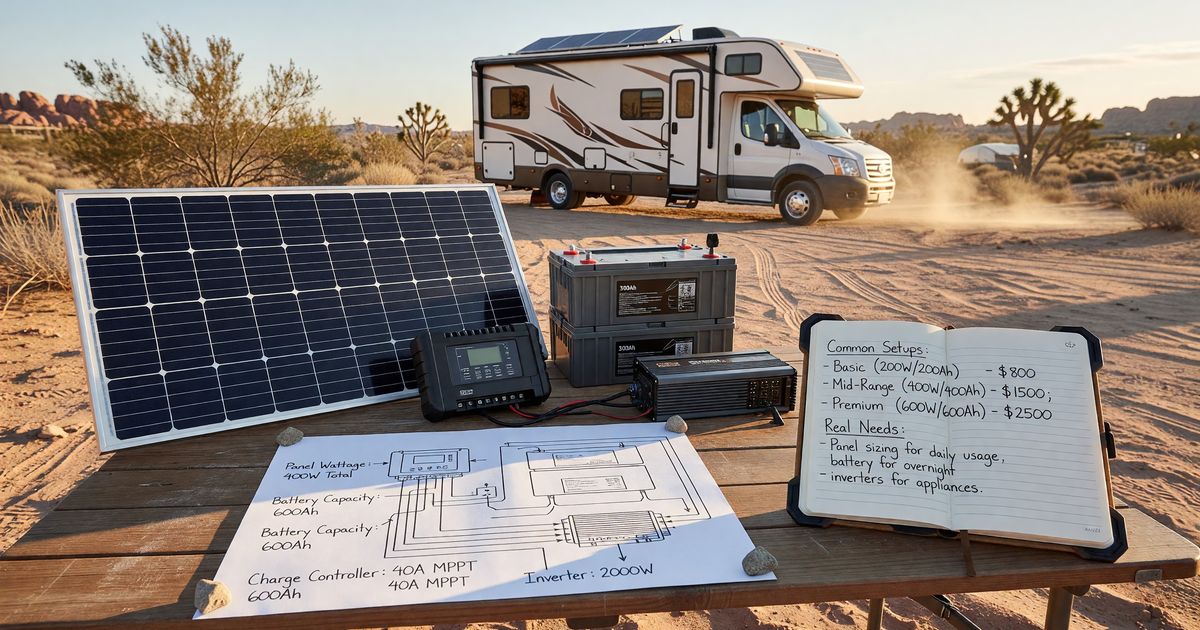
The RV solar conversation often starts wrong. People ask "how many solar panels do I need?" when the correct first question is "how much power do I actually use?" Those are not the same question, and starting with the wrong one leads to systems that are either woefully undersized or uselessly oversized.
This guide walks through the process of sizing a solar and battery system for actual RV use — daily consumption calculation, battery capacity selection, panel sizing, charge controller requirements, and inverter considerations. It is written for campers who want to reduce or eliminate generator dependence, not for people building off-grid power stations.
Step 1: Calculate Your Daily Power Consumption
Every appliance in your RV draws power measured in watts. How long it runs each day determines its daily energy consumption in watt-hours. Battery capacity and solar input must together cover this number.
Common RV loads:
| Appliance | Typical Wattage | Daily Use |
|---|---|---|
| 12V refrigerator (compressor) | 40-60W average | 24h = 800-1,000 Wh |
| Lights (LED) | 10-20W total | 4h = 40-80 Wh |
| Phone/device charging | 20-30W | 2h = 40-60 Wh |
| Fan (12V) | 20-50W | 8h = 160-400 Wh |
| CPAP (without heat) | 30-60W | 8h = 240-480 Wh |
| Propane furnace blower | 50-100W | Variable |
| Water pump (12V) | 50-100W | 0.5h = 25-50 Wh |
| Laptop charging | 45-90W | 2h = 90-180 Wh |
| TV (12V, 24 inch) | 30-50W | 2h = 60-100 Wh |
Add up your realistic daily loads. For a typical dry-camping setup with a compressor fridge, lights, CPAP, laptop, fan, and device charging, expect 1,200-2,000 Wh per day.
What is NOT realistic for solar-only RV power: Air conditioning. A single rooftop RV AC unit draws 1,300-1,600W and runs for hours. The panel array and battery bank required to run AC without hookups is beyond practical RV installation size for most rigs. Solar is excellent for everything but AC — for AC, you need hookups or a generator.
Step 2: Size Your Battery Bank
Your battery bank must hold enough energy to power your loads through a day plus a buffer for overcast days and partial charging.
The capacity math: If your daily load is 1,500 Wh, you need 1,500 Wh of usable battery capacity per day. The "usable" qualifier is critical and depends heavily on battery chemistry.
Lead-acid (AGM/flooded): Usable capacity is approximately 50% of rated capacity. A 200Ah lead-acid battery bank (rated at 12V, so 2,400 Wh total) provides approximately 1,200 Wh of usable energy before damaging the batteries through excessive discharge. For a 1,500 Wh daily load, you would need approximately 300Ah of lead-acid capacity.
Lithium (LiFePO4): Usable capacity is approximately 80-90% of rated capacity. A 200Ah lithium battery (2,400 Wh rated) provides 1,920-2,160 Wh of usable energy. For a 1,500 Wh daily load, 200Ah of lithium is approximately the right size with moderate buffer.
The lithium cost/benefit: Lithium batteries cost roughly 2.5-4x as much as equivalent AGM, but provide approximately double the usable capacity from the same amp-hour rating, charge faster, handle partial states of charge better, and have 3-5x the cycle life. For active boondockers, the total cost of ownership over the life of the system often favors lithium despite the higher upfront cost.
A practical starting point: 200Ah LiFePO4 (or 300-400Ah AGM) covers a moderate daily load of 1,200-1,800 Wh with a reasonable one-day buffer.
Step 3: Size Your Solar Array
Solar panels generate power measured in watts. Under ideal conditions (direct sun, perpendicular angle to the sun, 70-80°F ambient temperature), a 100W panel generates approximately 100W. In practice, you can expect 70-80% of rated output accounting for real-world losses.
More importantly, you need to account for peak sun hours — the number of hours per day during which solar irradiance is equivalent to 1,000 W/m². This varies by location, season, and cloud cover. For planning purposes:
- Southwest US (AZ, NM, CA desert): 5-6 peak sun hours per day average
- Pacific Northwest, cloudy regions: 2-3 peak sun hours
- Mid-continent US: 4-5 peak sun hours
- Winter months: reduce by 30-50% from summer peak
The sizing calculation: Daily load (Wh) ÷ Peak sun hours ÷ System efficiency factor (0.8) = Required panel wattage.
For a 1,500 Wh daily load in a 4-peak-sun-hour location: 1,500 ÷ 4 ÷ 0.8 = 469W of panel. In practice, 400W is a common starting install that covers this load in good sun, with a generator for overcast days.
Common practical installs:
- Light use (no fridge, some lighting/charging): 200W panel + 100Ah lithium
- Moderate use (compressor fridge, CPAP, devices): 400W panel + 200Ah lithium
- Heavy use (work-from-anywhere laptop-heavy): 600W+ panel + 300Ah lithium
Charge Controllers: MPPT vs. PWM
A charge controller sits between the solar panels and the battery bank, regulating the charging process.
PWM (Pulse Width Modulation): Less expensive, simpler technology. Effective for small systems. Significantly less efficient than MPPT — typically 75-80% efficient at converting panel output to battery charge. For systems under 200W with 12V batteries, PWM is cost-effective.
MPPT (Maximum Power Point Tracking): More expensive but 93-98% efficient. Actively finds the optimal operating point of the panel's output curve and converts excess panel voltage to additional charging amps. At panel voltages significantly higher than battery voltage, MPPT is dramatically more effective. For any system above 200W or using 24V/48V battery banks, MPPT is the standard choice.
The controller must be sized for your panel array's short-circuit current and your battery bank voltage. A correctly specified MPPT controller from Victron, Renogy, or equivalent reputable brands is a reliable investment that will outlast multiple panel upgrades.
Inverters: When You Need AC Power
Solar and batteries operate in DC (direct current). Standard household appliances and shore power connections run on AC (alternating current). An inverter converts DC from the battery bank to AC for appliances.
Pure sine wave inverter: Produces AC power identical in quality to shore power. Required for sensitive electronics (CPAP, laptops, monitors), variable-speed motors (refrigerators, fans), and any appliance with a switching power supply. The standard choice for RV use.
Modified sine wave inverter: Less expensive, produces a stepped approximation of AC. Works for simple loads (incandescent lights, some tools) but damages or interferes with sensitive electronics. Not recommended for RV use with modern electronics.
Sizing your inverter: The inverter must handle your maximum simultaneous AC load. Add up the wattage of everything you might run at the same time. A 1,000-2,000W pure sine inverter covers most non-AC RV loads.
Inverter-charger combination units: Shore power at a campground can recharge your battery bank efficiently through an inverter-charger (such as the Victron MultiPlus or the Xantrex Freedom series). These units function as both a shore-power battery charger when connected and an inverter when running on batteries — eliminating redundant equipment.
For campground options with electrical hookups that eliminate the need for battery management, see our guide to campground hookup types.
Frequently Asked Questions
How much solar do I need to run an RV? Calculate your total watt-hours per day, then size panels to generate that amount given your location's peak sun hours. A common moderate-use install for a compressor fridge, CPAP, and device charging is 400W of panels with a 200Ah lithium battery in a 4-peak-sun-hour location.
What is the difference between AGM and lithium RV batteries? AGM batteries are less expensive but provide only 50% usable capacity. Lithium (LiFePO4) batteries cost 2.5-4x more but provide 80-90% usable capacity, charge faster, handle partial states of charge, and last 3-5x longer in cycle count. For regular boondocking, total cost of ownership often favors lithium.
Can solar power an RV air conditioner? Not practically for most installations. A single AC unit draws 1,300-1,600W and would require a very large panel array and battery bank. For air conditioning, electrical hookups or a generator are the practical solutions.
What is MPPT and do I need it? MPPT charge controllers efficiently convert panel output to battery charge — 93-98% efficiency vs. 75-80% for PWM. For any system above 200W, MPPT delivers meaningfully more charging current from the same panels.
Do I need a pure sine wave inverter for my RV? Yes. CPAP machines, laptops, and modern electronics require pure sine wave AC. Modified sine wave inverters damage sensitive electronics over time. A pure sine wave inverter is the correct starting point.
Further Reading from Authoritative Sources
- Go RVing — Off-Grid and Boondocking Guide — Practical overview of self-sufficient RV camping including power system considerations.
- RVIA — RV Electrical Systems — Industry standards and consumer guidance on RV electrical system components and safety.