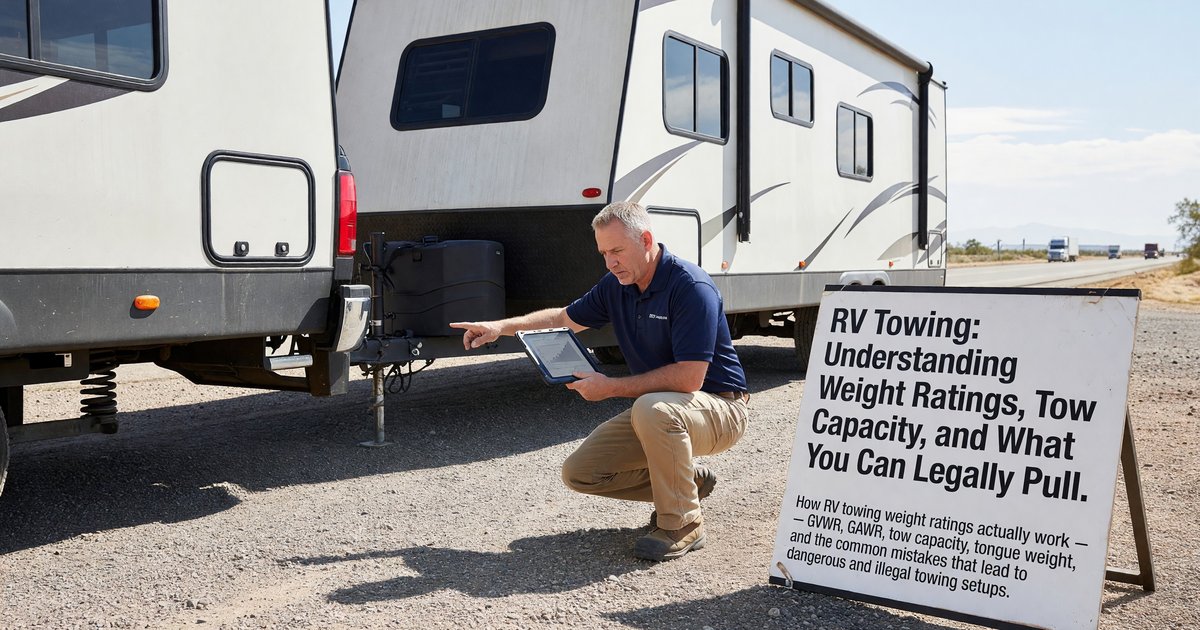
The most common towing mistake in the RV world is not overloading by a massive margin — it is overloading by just enough that nothing catastrophic happens on most trips, while systematically stressing transmission, brakes, and suspension until something fails. A truck rated to tow 10,000 pounds pulling an 11,500-pound trailer does not feel dramatically different on flat highway. It feels very different going downhill on a mountain pass.
Understanding RV towing weight ratings is not optional for safe operation. It is the foundation. This guide covers what the ratings mean, how they interact, and how to verify that your towing setup is actually within spec.
The Weight Ratings That Matter
Every vehicle and trailer involved in an RV towing setup has multiple weight ratings stamped on a label inside the driver's door jamb (vehicles) or on a plate inside the trailer frame. These are engineering limits, not guidelines.
GVWR — Gross Vehicle Weight Rating: The maximum loaded weight of the trailer as a standalone unit. Includes the trailer itself plus everything in it — gear, water, propane, food, clothing, everything. GVWR is the ceiling. Your loaded trailer may not exceed this number.
GAWR — Gross Axle Weight Rating: The maximum weight each individual axle can carry. A trailer with a 14,000-lb GVWR and two axles each rated at 7,000 lbs has a 14,000-lb combined capacity — but both axles must individually stay within their 7,000-lb limits. Uneven loading can exceed individual axle limits even when total GVWR is not reached.
Tow Vehicle GCWR — Gross Combined Weight Rating: The maximum combined weight of the tow vehicle (loaded) plus the trailer (loaded). This number is less commonly found but applies when calculating whether your full setup — truck and trailer, both fully loaded — stays within the truck manufacturer's specification.
Tow Vehicle Tow Capacity: The most commonly cited number, but also the most often misapplied. A truck's advertised tow capacity is its maximum under a specific configuration — specific engine, transmission, axle ratio, cab/bed configuration. The tow capacity badge on a truck's tailgate may reflect a configuration you do not have. Find your vehicle's specific tow capacity using the VIN decoder on the manufacturer's website or the owner's manual towing guide for your specific vehicle build.
Tongue Weight Capacity: The portion of the trailer's total weight carried by the hitch ball. For a conventional ball hitch, tongue weight should be 10-15% of the trailer's total loaded weight. Tongue weight rating on the hitch and the tow vehicle must both be respected — the hitch is frequently the binding constraint.
The Two Mistakes That Matter Most
Mistake 1: Using the max tow capacity number without accounting for payload.
Tow capacity and payload capacity are both limits, and they work against each other. If your truck has a 2,000-lb payload capacity (the weight of everything in and on the truck — passengers, cargo, fuel, fifth-wheel pin weight or tongue weight from the hitch), and you put 300 lbs of passengers and gear in the truck plus 600 lbs of hitch tongue weight, you have 1,100 lbs of payload used. Put a heavier trailer on, and your tongue weight may push you over payload capacity before you approach the advertised tow limit.
The payload placard is inside the driver's door jamb — it is a specific number for that specific truck, calculated after accounting for the truck's actual components. Do not use a payload number from a review or an online comparison. Use the placard in that specific truck.
Mistake 2: Weighing only the unloaded trailer.
A trailer's dry weight (typically found in the spec sheet or on the side of the trailer) is the manufacturer's stated weight with no options, no gear, no water, no propane, and often a liberal interpretation. A trailer listed at 6,500 lbs dry weight can easily hit 8,500-9,000 lbs when fully loaded for a two-week trip. The only number that matters for determining whether you are within limits is your actual loaded weight, measured on a scale.
The Recreational Vehicle Industry Association (RVIA) provides industry weight standards and guidance on how manufacturers calculate and report trailer weights — the gap between dry weight and actual loaded weight is a documented and consistent issue across the industry.
How to Actually Weigh Your Trailer
The correct procedure is to weigh your trailer after it is fully loaded for travel, not empty, and not with an estimated weight.
CAT scale locations (catscale.com) at truck stops nationwide allow you to weigh your entire tow vehicle and trailer setup, and most provide individual axle weights. The fee is approximately $12-15 per weigh. You want:
- Total combination weight (truck + trailer combined)
- Individual axle weights for both vehicle and trailer axles
With individual axle weights, you can verify GAWR compliance for each axle in addition to total GVWR.
Weigh after you are packed for a typical trip — the weight that matters is the weight you actually travel with.
Weight Distribution Hitches and Sway Control
For trailers with significant tongue weight, a weight distribution hitch (WDH) changes the effective loading on the tow vehicle axles by using spring bars to redistribute tongue weight across the vehicle's front axle. A properly set WDH keeps the tow vehicle level and improves steering feel, braking, and overall stability.
When a WDH is required: Most fifth wheel setups do not use WDH (the pin weight loads the truck bed directly over the rear axle). For conventional ball hitches, a WDH is generally recommended when the trailer's tongue weight exceeds 10% of the tow vehicle's front axle GAWR, or when the truck's nose visibly rises when connected to the trailer.
Sway control — either a friction sway bar (older technology) or an integrated weight distribution head with sway control (better) — addresses trailer yaw oscillation. At highway speeds, a trailer with a marginal load distribution or light tongue weight can begin to oscillate laterally. An integrated sway control system damps this before it develops into a tank slapper. The RVIA safety guide covers trailer stability in detail.
Electric Brakes: Requirements and Function
Any trailer over a certain weight threshold is required by law (in most states, 3,000 lbs is the common threshold — but it varies by state) to have a functioning electric brake system. The brakes in the tow vehicle cannot adequately stop the combined weight of the rig in an emergency without trailer brakes contributing.
Electric trailer brakes are activated by a brake controller installed in the tow vehicle. Two types exist:
Proportional brake controllers measure deceleration force (via an accelerometer) and apply trailer brakes proportional to how hard the tow vehicle is braking. This produces the smoothest, most balanced braking across the combination.
Time-delayed brake controllers apply trailer brakes after a set delay, regardless of how hard the tow vehicle is braking. Less sophisticated and increasingly uncommon in new vehicles, but functional.
Many newer trucks include a factory brake controller. Verify yours is functional, correctly calibrated, and actually wired to the trailer's brake plug before any significant tow.
Frequently Asked Questions
What is the difference between tow capacity and payload capacity? Tow capacity is the maximum weight the vehicle can pull behind it. Payload capacity is the maximum weight the vehicle can carry in the cab, bed, and transferred from the hitch. These limits interact: tongue weight from the trailer uses up payload capacity. A truck can be within tow capacity but over payload capacity if hitch tongue weight and cargo are not accounted for together.
What is GVWR on a trailer? GVWR (Gross Vehicle Weight Rating) is the maximum allowable loaded weight of the trailer — the trailer itself plus everything loaded in it, including water, propane, gear, and cargo. It is an engineering limit. The trailer's actual loaded weight must never exceed the GVWR.
How do I find out my truck's actual tow capacity? Use the VIN decoder on the manufacturer's website or the towing guide in your owner's manual to find the rated capacity for your actual build configuration. The advertised number on the truck may reflect a different trim and axle configuration.
Do I need a weight distribution hitch for my trailer? A WDH is recommended for conventional ball-hitch trailers when tongue weight exceeds 10% of the tow vehicle's front axle GAWR, or when the truck's nose rises when connected. Fifth wheel setups generally do not require a WDH.
Are trailer brakes required? Most states require functioning electric trailer brakes on trailers over a certain weight, commonly 3,000 lbs. Beyond legal requirements, trailer brakes are a safety necessity for stopping a loaded combination at highway speeds.
Further Reading from Authoritative Sources
- Recreational Vehicle Industry Association — RV Safety — RVIA consumer guidance on trailer weight standards, towing safety, and electric brake requirements.
- ARVC — Campground Operator Resources — National Association of RV Parks and Campgrounds resources covering RV industry standards and campground-RV compatibility.