The outdoor recreation world has made significant progress in accessible infrastructure over the past two decades, but that progress has been uneven. Some campgrounds have outstanding accessibility — paved pads, accessible vaults, beach access mats, and fishing piers designed specifically for wheelchair users. Others meet the minimum ADA standard on paper but fall short in practice. Knowing the difference before you arrive requires both knowing what to look for and knowing how to verify it.
This guide covers the ADA requirements for campgrounds, what features are most important for specific mobility needs, how to find accurately described accessible sites, and resources for adaptive camping programs.
What the ADA Requires for Campgrounds
The Americans with Disabilities Act, as it applies to outdoor recreation areas, is implemented through standards developed by the US Access Board and incorporated into USDA and NPS design guidelines. The standards cover campsite features specifically.
Accessible campsite requirements:
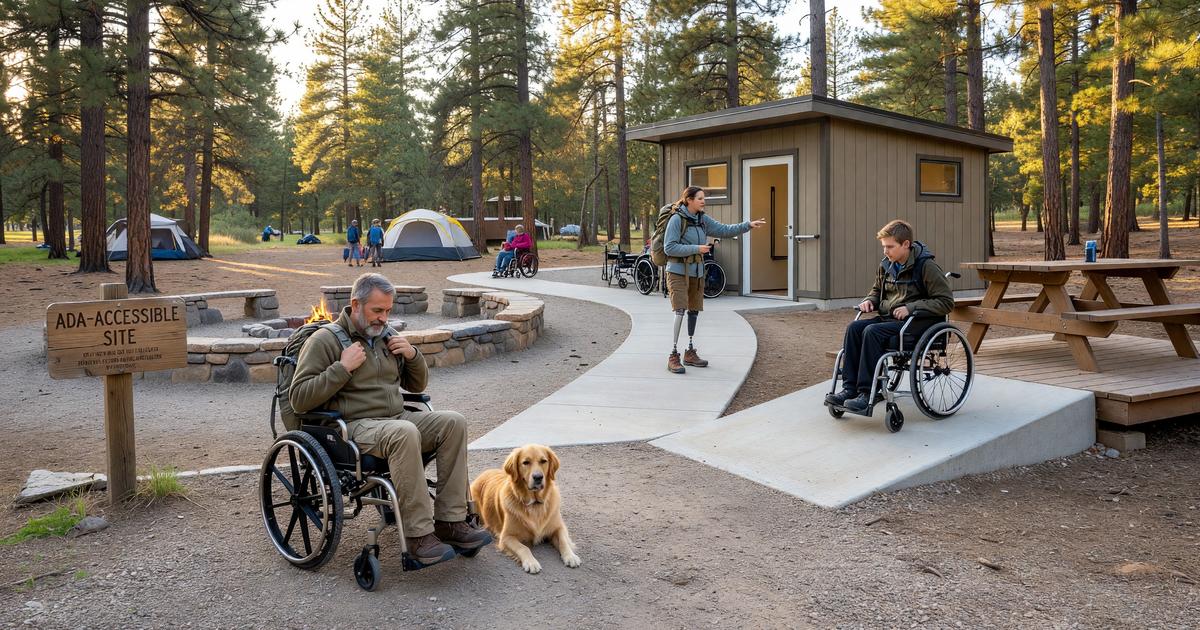
- A firm, stable, and slip-resistant camping surface (pad)
- An accessible route connecting the site to accessible facilities (toilets, water, trailheads)
- A clearing with sufficient dimensions to allow a camping unit, picnic table, and fire ring to be arranged with clear turning space for a mobility device
- The picnic table must have accessible seating — at least one surface usable by a person in a wheelchair
- The fire ring must be positioned at a height accessible from a seated position (elevated fire rings — between 15 and 34 inches off the ground — are the accessible standard)
What is not standardized: The percentage of sites required to be accessible (typically a minimum of one per camping area, with more depending on total site count), and the specific surface material. "Firm and stable" is required; smooth concrete is the most compliant interpretation, but packed gravel and compacted decomposed granite can also meet the standard.
The ADA itself provides the legal framework; detailed guidance on outdoor accessible design is provided by the US Access Board's supplemental recreation guidelines.
What Actually Matters: Features That Make a Difference
Site surface material. Paved or concrete pads are the most universally navigable for manual and power wheelchair users. Packed gravel can work for power chairs; it is often difficult for manual chairs and for anyone with limited upper body strength. Wood chip surfaces are generally not accessible. If the campground's accessible sites are described as "gravel," call and ask about the grade and compaction before booking.
Toilet and shower access. An accessible restroom that requires crossing unpaved ground, navigating a threshold, or pushing through a heavy door can defeat its own accessibility. The accessible route from the site to the restroom matters as much as the restroom itself. Call the campground and ask specifically: is the route from the accessible site to the accessible restroom entirely paved?
Elevation change. ADA standards allow routes up to 5% cross slope and 8.33% running slope on accessible routes. Many campgrounds in mountainous terrain technically comply while still being genuinely difficult to navigate in a manual wheelchair. For manual wheelchair users, nearly-flat sites are significantly more usable than technically-compliant sloped ones.
Shower access. Roll-in showers versus transfer showers. Roll-in showers allow direct entry from a wheelchair; transfer showers have a bench and require the user to transfer from the chair. If a roll-in shower is required, confirm this specifically with the campground — "accessible shower" is sometimes used interchangeably for both configurations.
Water faucet height. Accessible water faucets should be operable without grasping and at a reach height of 15-48 inches. Ask whether the campground's water access meets these specifications.
How to Find Accurately Described Accessible Sites
The booking platforms for campgrounds have improved in accessible site documentation but remain inconsistent.
Recreation.gov allows filtering by accessibility features and provides a site-level description of accessibility amenities at federal campgrounds. The descriptions vary in quality — some are detailed and accurate; others are minimal. For any trip where accessibility is a practical necessity, supplement the recreation.gov description with a phone call to the campground or ranger station.
ReserveAmerica (used by many state park systems) similarly has accessibility filtering. State-by-state quality of the documentation varies. Some state park systems (California, Virginia, Michigan) have invested in comprehensive accessible site inventories; others have limited documentation.
Disabled Sports USA (dsusa.org) and Outdoor Afro are community-connected resources that provide user-generated reviews and recommendations for accessible outdoor recreation from people with direct lived experience of camping with disabilities — often more practically useful than official documentation.
Free Wheelchair Mission and various state adaptive programs operate specific accessible camping trips and programs; a search for adaptive camping in your state often surfaces organized programs with pre-vetted accessible campgrounds.
Campground Systems with Strong Accessible Records
Several campground systems have made documented, consistent investments in accessible infrastructure:
National Park Service developed campgrounds at major parks have received significant accessibility retrofits over the past decade under NPS accessibility improvement programs. Campgrounds like Elkmont (Great Smoky Mountains), Furnace Creek (Death Valley), and many Acadia campgrounds have accessible sites with solid paved pads, elevated fire rings, and accessible routes to facilities.
California State Parks has a well-documented accessibility inventory and several campgrounds specifically cited for quality accessible infrastructure — Salt Point State Park, Millerton Lake, and Lake Oroville have received positive reviews from accessible camping communities.
Corps of Engineers campgrounds (Army Corps of Engineers-managed reservoirs) have often invested more in accessible infrastructure than state parks of comparable size, partly due to federal accessibility funding streams. COE campgrounds near major reservoirs in the South and Midwest frequently have well-maintained accessible sites.
Adaptive Camping Programs
Beyond infrastructure, organized adaptive programs provide equipment, support, and expertise that make camping accessible to people who might not attempt it independently.
Disabled Sports USA operates chapters nationwide with outdoor recreation programs including camping. Equipment lending (hand cycles, beach wheelchairs, adaptive fishing equipment) is available through many chapters.
The National Ability Center in Park City, Utah offers adaptive outdoor programs including camping and has relationships with accessible campground operators in the region.
Many state parks have loaner equipment programs: California State Parks has beach wheelchair programs at accessible beaches; several Great Lakes state park systems have lending programs for adaptive kayaking and fishing equipment. Call the specific park before visiting to ask about equipment availability.
For campground booking strategies more generally, see our guide to booking state park campsites.
Frequently Asked Questions
What does an ADA-accessible campsite include? A firm, stable camping surface; an accessible route to restrooms and water; accessible picnic table seating; and a fire ring at a height usable from a seated position (typically 15-34 inches elevated). The site must be level enough to navigate with a mobility device.
How do I book an accessible campsite at a national park? Book through recreation.gov, use the accessibility filter, then call the campground or ranger station to confirm specific features — surface material, route to restrooms, and shower configuration. Some accessible sites have separate reservation pools with reduced competition.
What is the difference between a roll-in shower and a transfer shower? A roll-in shower allows direct wheelchair entry. A transfer shower requires the user to transfer to a bench. If you cannot transfer independently, a roll-in shower is required — confirm which type is available before booking.
Are gravel campsite pads accessible? Depends on compaction. Well-compacted decomposed granite can meet ADA standards; loose gravel does not. For manual wheelchair users, paved pads are significantly easier regardless of compaction. Call the campground to ask about surface quality specifically.
Are there camping programs specifically for people with disabilities? Yes. Disabled Sports USA operates adaptive outdoor programs nationally. The National Ability Center in Utah offers adaptive camping. Many state park systems have beach wheelchair and adaptive equipment lending programs.
Further Reading from Authoritative Sources
- US Access Board — Outdoor Recreation Guidelines — Official guidelines for accessible design at campgrounds, trails, and outdoor recreation areas under the ADA and Architectural Barriers Act.
- National Park Service — Accessibility in National Parks — NPS accessibility resources including campground accessibility ratings, adaptive program listings, and a park-by-park accessibility guide.