Horse camping occupies a niche in the campground world that requires specific research — campgrounds that accommodate horses are a minority of all campgrounds, the facilities they offer vary significantly, and the etiquette and logistics of camping with horses are different enough from conventional camping that unprepared first-timers create problems for themselves and everyone around them.
The state and national park systems have made genuine investments in equestrian camping infrastructure over the past two decades. The result is a national network of horse camps that, taken together, provides access to some of the best trail riding in the country in combination with overnight camping facilities. Finding them requires knowing where to look.
What an Equestrian Campsite Requires
A horse camping facility differs from a conventional campground at the site level:
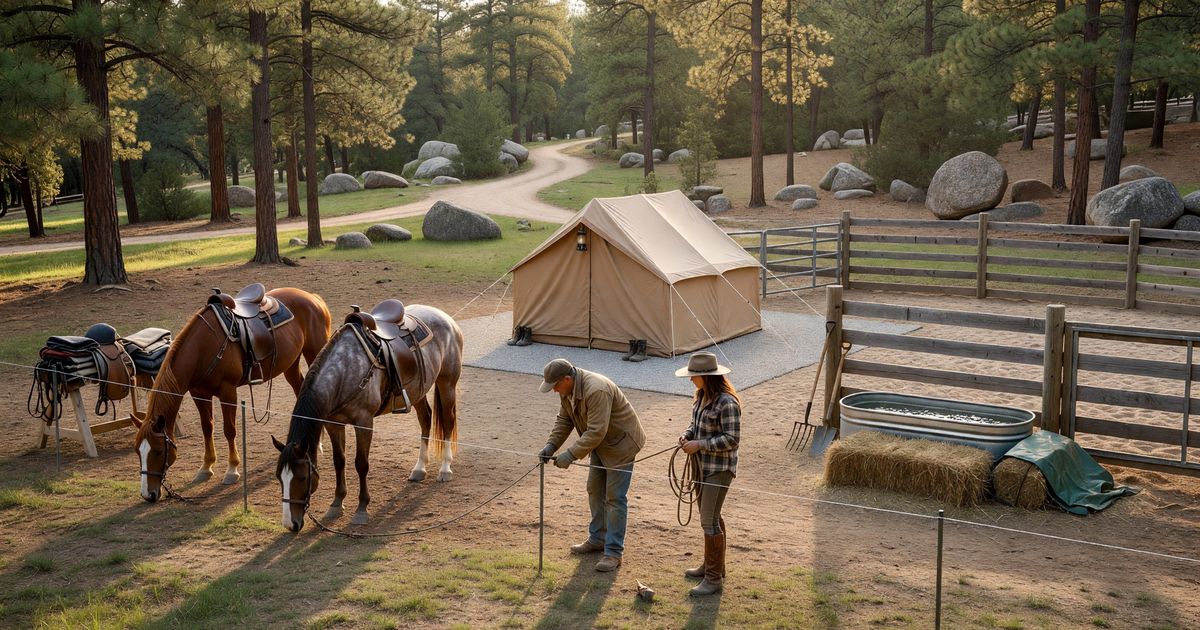
High-line or corral facilities. Horses need to be contained overnight. High-line cables strung between trees (a system requiring a proper knot and tree protection) or pipe corrals are the two standard solutions. Some horse camps provide pipe corrals at each site; others have shared corrals or central high-line areas; others leave the containment solution to the horse camper. If you need to know before booking, call and ask specifically.
Water for horses. A horse drinks 8-15 gallons of water per day under normal conditions; more in heat or heavy work. A campground water source adequate for human use is not necessarily adequate for horses. Look for horse camps with stock tanks, automatic waterers at sites, or creek/river access. If there is a pump only, know that hand-pumping 15 gallons per horse per day is significant labor.
Trailer parking. A horse trailer requires significantly more turning radius and parking space than an RV. Most horse camping areas accommodate this, but confirm that the parking area is functional for the specific trailer length you bring.
Manure management. Horse camps with established facilities typically have designated manure disposal areas. "Pack it in, pack it out" applies to manure in Leave No Trace camping settings; at developed horse camps, the dump area may be the designated solution. Know the campground's policy before arrival.
Grazing restrictions. Most state and national park horse camps prohibit grazing on park vegetation — both for ecological reasons (protecting native plants) and practical ones (risk of toxic plant ingestion). You are responsible for bringing all feed for your horses. Hay and grain need to be packed in sufficient quantity for the full trip.
How to Find Equestrian Campgrounds
Recreation.gov has an "equestrian" filter in its amenities search. Federal campgrounds — national forests, national parks with equestrian programs, Bureau of Reclamation and Corps of Engineers sites — are covered. This is the best single starting point for federally managed horse camps.
State park systems have variable equestrian facility documentation. Some state park systems have a dedicated equestrian program with documented trail mileage, corral capacity, and trailer parking specs. Others simply list "horses allowed" with minimal additional information. Contacting the specific park by phone remains the most reliable way to understand what is actually available.
The American Trails database (americantrails.org) documents multi-use trails including equestrian access, with connections to camping facilities. Trail quality and camping proximity together are searchable.
Horse camping communities online — forums and Facebook groups specific to horse camping in particular states — provide user-generated reviews that are often more practically useful than official descriptions, particularly for specific facility quality (is the corral actually solid? Is the water actually reliable?).
Regional Standouts for Equestrian Camping
East: Appalachian Trail Corridors and Southeast Forests
Virginia's Grayson Highlands State Park is among the best equestrian camping destinations in the East. The park has extensive maintained trail systems with equestrian access, pipe corrals at the horse camping area, and access to some of the most spectacular highland terrain in the southern Appalachians — including open balds where semi-wild ponies roam. The horse camp books quickly for fall weekends.
Uwharrie National Forest in North Carolina has a dedicated horse camp (Arrowhead Campground) with corrals, good forest trail access, and reliable facilities. Less dramatic scenery than Grayson Highlands but more reliably available.
George Washington and Jefferson National Forests in Virginia have multiple horse camps along the trail system — the Todd Lake Recreation Area and North River Campground both offer equestrian facilities with trail access.
Midwest: Prairie and Forest Trail Networks
Illinois' Shawnee National Forest has the Garden of the Gods Wilderness and the River to River Trail, with horse camps at Trigg Tower and other locations. Flat-to-rolling terrain makes it accessible to horses and riders of varying fitness.
Missouri's Mark Twain National Forest has extensive equestrian trail networks with horse camps throughout — the Cedar Bluffs and Sutton Bluffs areas are consistently well-regarded by the equestrian camping community.
West: National Forest and BLM Trail Systems
The western national forests have some of the most extensive equestrian trail systems in the country, with horse camps integrated throughout.
Bridger-Teton National Forest in Wyoming provides access to some of the most dramatic backcountry trail riding in the lower 48, with trailhead horse camps at Big Sandy Lodge (for the Wind River Range) and Teton Canyon. High elevation and short access windows are practical considerations.
Inyo National Forest in California (Eastern Sierra) has horse camps at Convict Lake, Horseshoe Meadow, and several pack station trailheads that provide access to the John Muir Wilderness and high Sierra trail systems. The Horseshoe Meadow site at 10,000 feet elevation is a staging area for multi-day backcountry trips.
Practical Preparation
Coggins testing. Most campgrounds requiring horses to cross state lines or enter managed land require a current Coggins test (EIA/equine infectious anemia test), typically within 6-12 months. Carry a printed copy of the Coggins certificate in your trailer.
Health certification. Interstate travel with horses typically requires a current health certificate (Certificate of Veterinary Inspection) issued within the past 30 days. Requirements vary by destination state — check the state agriculture department website for your destination.
Feed management. Pack more hay and grain than your calculated needs. Running short is not an option — commercial feed sources near remote horse camps are not reliable. Certified weed-free hay is required in some parks and wilderness areas; if it is required at your destination, it will be posted.
Trail preparation. Know the mileage, elevation, and difficulty of the trails you plan to ride before departure. A horse at 10,000 feet in altitude needs time to acclimate. Trails with heavy timber blowdown or creek crossings may not be current conditions — call the ranger district for a current trail report.
For state park campground booking strategies, see our guide to state park camping reservations.
Frequently Asked Questions
What facilities should an equestrian campground have? High-line cables or pipe corrals for overnight containment, reliable water in adequate volume (8-15 gallons per horse per day), trailer parking, and a designated manure disposal area. Trail access directly from the campground is the primary selection criterion.
Can I bring my horse to a national park? Some national parks have designated equestrian trails and backcountry horse camps. Many park trails prohibit horses. Check the specific park's equestrian use page on nps.gov before planning.
Do I need a Coggins test to camp with my horse? Most campgrounds and public lands require a current negative Coggins test (within 6-12 months). Carry a printed copy in your trailer at all times when traveling with horses.
Can my horse graze at a campground? Typically not at state and national park horse camps — grazing on park vegetation is prohibited. Bring all feed, including certified weed-free hay if required by the specific park or wilderness area.
How do I find equestrian campgrounds in my region? Use recreation.gov's equestrian filter for federal sites. Contact state park systems directly. American Trails (americantrails.org) documents multi-use trails with equestrian access. State-specific horse camping communities online provide the most practically useful site-specific information.
Further Reading from Authoritative Sources
- National Park Service — Equestrian Use in National Parks — NPS guidance on which parks accommodate horses, equestrian trail etiquette, and how to find horse camp facilities.
- ARVC — Equestrian Campground Standards — National Association of RV Parks and Campgrounds standards and resources covering equestrian facility requirements at private campgrounds.