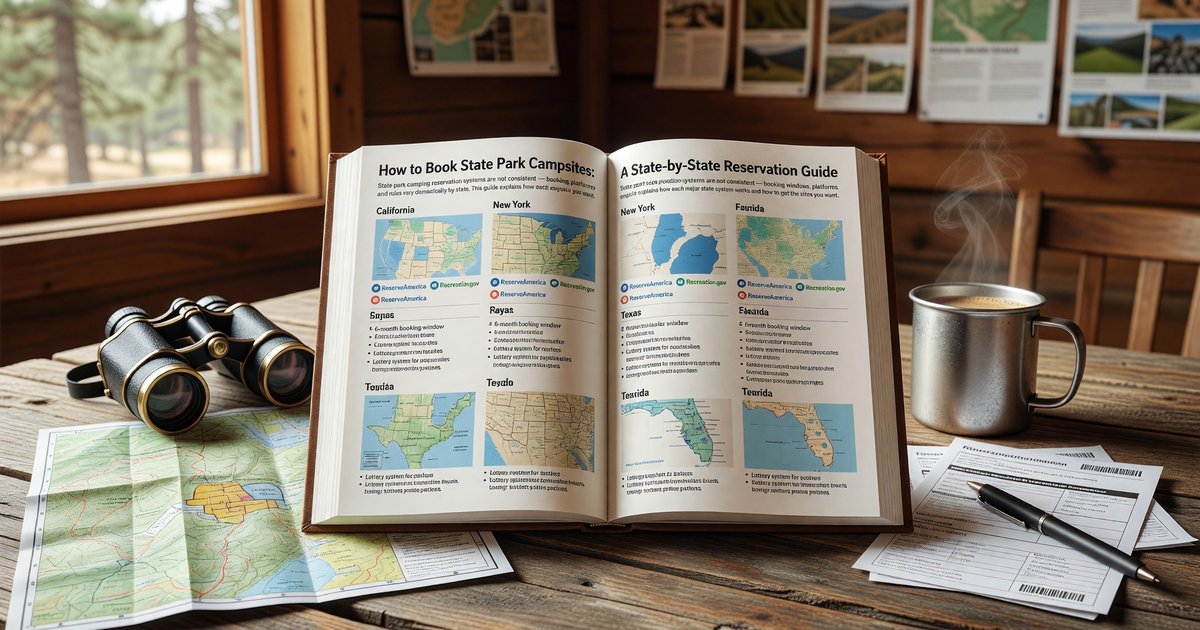
If you have ever tried to book a campsite at a popular state park and come up empty despite being on the booking site at exactly the right time, you have experienced one of American camping's most frustrating realities: state park reservation systems are not standardized, not intuitive, and not consistent from state to state.
The booking window at a California state park is different from New York, which is different from Colorado. Some states use Reserve America / ReserveCA. Others use recreation.gov. Many have their own proprietary platforms. The cancellation policies differ. The release timing differs. Even the definition of what counts as a "full hookup" differs.
This guide covers how the major state park reservation systems work, which states have the most competitive booking environments, and the practical tactics that experienced campers use to get the sites they want.
The Major Reservation Platforms
Most state parks use one of a handful of platforms:
Reserve America / Aspira (reserveamerica.com, reservecalifornia.com, reserveamerica.com/explore/state-parks) — The most widely used platform for state parks. Booking windows vary by state but typically open 3-6 months ahead. The platform handles states including Florida, Virginia, Oregon, and dozens of others.
recreation.gov — Best known as the federal parks booking platform (National Park Service, Bureau of Reclamation, Army Corps of Engineers campgrounds), recreation.gov also handles campgrounds in some states. Washington State Parks moved to recreation.gov in 2022.
State-specific systems — Several states run their own platforms:
- California: ReserveCA (reservecalifornia.com)
- New York: ReserveAmerica (newyorkstateparks.reserveamerica.com)
- Texas: Texas Parks and Wildlife (texasstateparks.reserveamerica.com)
- Michigan: Michigan DNR Reservations (midnrreservations.com)
- Minnesota: Reserve Minnesota (reservemn.usedirect.com)
- Colorado: Colorado Parks and Wildlife (cpwshop.com)
First-Come-First-Served — Many state parks still have a portion or all of their sites available on first-come-first-served basis, particularly mid-week and off-season. Some entire campgrounds are FCFS only.
Booking Windows by State
Booking windows — how far in advance you can make a reservation — are one of the biggest variables between states. Here are the key ones for popular camping destinations:
| State | Platform | Booking Window | Notes |
|---|---|---|---|
| California | ReserveCA | 6 months (180 days) | Releases at 8 AM Pacific; high-demand sites sell out in minutes |
| New York | ReserveAmerica | 9 months | One of the longest windows in the US |
| Florida | ReserveAmerica | 11 months | Extremely long; winter/spring dates for popular parks sell out fast |
| Texas | ReserveAmerica | 5 months | Good selection available; most parks are not as pressure-competitive |
| Washington | recreation.gov | 6 months | Consistent with national park pattern; sold out quickly for San Juan Islands |
| Oregon | ReserveAmerica | 6 months | Oregon Coast campgrounds are extremely competitive in summer |
| Colorado | CPW system | 6 months | Popular front-range parks (Chatfield, Cherry Creek) book out fast |
| Michigan | MI DNR | 6 months | Upper Peninsula parks often available; lower peninsula summer sites competitive |
| Minnesota | Reserve MN | 4 months | Boundary Waters canoe area permits separate from state park system |
California: The Hardest State Park Reservations in the US
California state parks — particularly the coastal campgrounds — have some of the most competitive reservation environments anywhere in the country. Sites at Pfeiffer Big Sur, Julia Pfeiffer Burns, Bodega Bay, and the Channel Islands book out within seconds of becoming available.
California's window opens at exactly 8:00 AM Pacific time, six months before the desired date. Being at your computer at 7:59 AM is not enough — you need to have your ReserveCA account logged in, your party information saved, and your preferred site queued up so that at 8:00 AM you are clicking the book button, not filling out fields.
For coastal campgrounds like Kirk Creek, Pfeiffer Big Sur, or Morro Bay:
- Create your ReserveCA account and add payment information ahead of time
- Know exactly which site number you want (site-specific reservations are common)
- Open the booking page the day before and bookmark the exact URL for your target site/date
- At exactly 8:00 AM on the release morning, refresh and book
If you miss the initial window, California state park cancellations come through steadily. ReserveCA does not have an alert system, but checking back in the 2-4 week window before your trip frequently turns up openings.
Florida: Book Almost a Year Out
Florida state parks are popular among snowbirds and winter visitors from the northeast, which means the most-desirable parks (Bahia Honda in the Keys, Grayton Beach on the Gulf Coast, Anastasia near St. Augustine) fill up very early for January through March dates. Florida's 11-month window means February dates go on sale in March of the prior year. If you want to camp in Florida in winter, treat the booking window opening as a recurring calendar event.
Summer camping in Florida state parks is less competitive (it is hurricane season and extremely hot) and often available well in advance.
New York: Nine-Month Window, But Plan Around It
New York's 9-month booking window is both an advantage and a planning requirement. Popular Adirondack and Catskills state campgrounds (Letchworth, Allegany, Saratoga) sell out summer weekends early. The upside is that 9 months out, you can plan with substantial lead time.
New York also has a large number of primitive lean-to shelters within its state forests, booked through the same system, that often remain available when campground sites are gone.
Oregon: Coastal Sites Are Summer Gold
Oregon's coast is one of the most scenic camping environments in the US, and everyone knows it. Cape Lookout, Carl Washburne, Honeyman State Park — summer weekend reservations are gone within the first hour of the booking window opening. The Oregon coast reservation situation is comparable to California's most competitive parks.
Inland Oregon state parks (Wallowa Lake, Crater Lake adjacent campgrounds, Farewell Bend) are easier to book and offer excellent camping in their own right.
Tactics That Actually Work
Know your exact dates and have a fallback — When you go into a booking session, know your first-choice site AND your second-choice site. If your first choice is gone, you can pivot immediately rather than losing time clicking around.
Cancellation monitoring — Most state park systems do not send cancellation alerts. Checking manually in the 2-week window before a high-demand date often turns up last-minute openings from people who changed plans.
Mid-week and shoulder season — Removing Friday and Saturday nights from your search dramatically expands availability. Many campgrounds that are impossible to get on weekends have Tuesday-Wednesday-Thursday openings available year-round.
Consider adjacent parks — If your first-choice state park is booked, look at the next park in the same region. Many states have multiple campgrounds within 30-60 minutes of each other with similar access to the same recreation areas.
Call the park directly — For parks with FCFS sites, calling the campground host or visitor center on a Wednesday morning to ask about weekend availability is underused. Staff can tell you how the site mix looks and whether arriving Friday afternoon or Saturday morning is realistic.
For planning camping trips around major national parks, see our guide to campgrounds near national parks. For families planning camping trips, our campground activities for kids guide covers what to look for in family-friendly sites.
Understanding Site Types at State Parks
State park campground site types vary in what they offer. Knowing the terminology prevents booking surprises.
Standard / Tent site — Flat cleared area with a picnic table and fire ring. May or may not have a tent pad. No utility hookups.
Electric only — Standard 20-amp or 30-amp outlet at the site. No water or sewer connection.
Water and Electric (Partial Hookup) — Electric plus a water spigot at the site. You manage grey and black tank waste yourself and use the dump station.
Full Hookup — Electric, water, and sewer at the site. Common at dedicated RV areas within state parks. Less common than at private campgrounds.
Equestrian sites — Sites with horse-friendly amenities including corrals or high lines. Only relevant to horse camping.
Waterfront / Premium sites — A pricing tier, not a utility description. Indicates location advantage (lakefront, beachfront, ridgeline view). Often costs $10-30 more per night.
When filtering search results, make sure the site type matches your camping setup. Booking an electric-only site in an RV that needs full hookups means a dump station run that may or may not be convenient.
Frequently Asked Questions
How far in advance can I book a state park campsite? Booking windows vary by state. Florida allows reservations up to 11 months ahead, New York 9 months, and most states including California, Washington, Oregon, and Colorado open reservations 6 months before the desired date. A few states use shorter windows of 3-5 months.
What is the best website to book state park campsites? There is no single platform — state park booking systems are not unified. Major platforms include Reserve America (many states), ReserveCA (California only), recreation.gov (Washington State Parks plus federal sites), and state-specific systems for Texas, Michigan, Minnesota, Colorado, and others. Always check your specific state's parks agency website for the correct booking platform.
Can I get a state park campsite without a reservation? Yes, many state park campgrounds still maintain first-come-first-served sites. Mid-week availability is significantly better than weekends. Calling the park directly can give you a realistic picture of FCFS site availability before you make a long drive.
Which states have the hardest state park camping reservations to get? California coastal parks (Pfeiffer Big Sur, Kirk Creek, Bodega Bay), Florida winter campgrounds (Bahia Honda, Grayton Beach), and Oregon coastal parks (Cape Lookout, Honeyman) are among the most competitive in the US. Popular Adirondack campgrounds in New York and front-range Colorado parks also see intense demand for summer weekend dates.
What is the difference between partial hookup and full hookup at state parks? Partial hookup (water and electric) provides an electrical outlet and a water spigot at your site but no sewer connection. You use the campground dump station for holding tanks. Full hookup adds a sewer inlet at the site, allowing you to drain continuously without moving your rig.