Fall is the best camping weather most of North America gets. It is also hunting season, and those two facts occupy the same forests, the same national grasslands, and a good share of the same state land.
The common reactions are both wrong. Avoiding public land from September to December gives up the best months of the year. Ignoring hunting seasons entirely is how people end up somewhere they should not be, at the hour they should not be there, dressed in brown.
The workable answer is neither. It is knowing which seasons are open where you are going, dressing so that you are unmistakably not a deer, and adjusting your timing by about two hours on each end of the day.
Blaze Orange Is Not Optional Gear
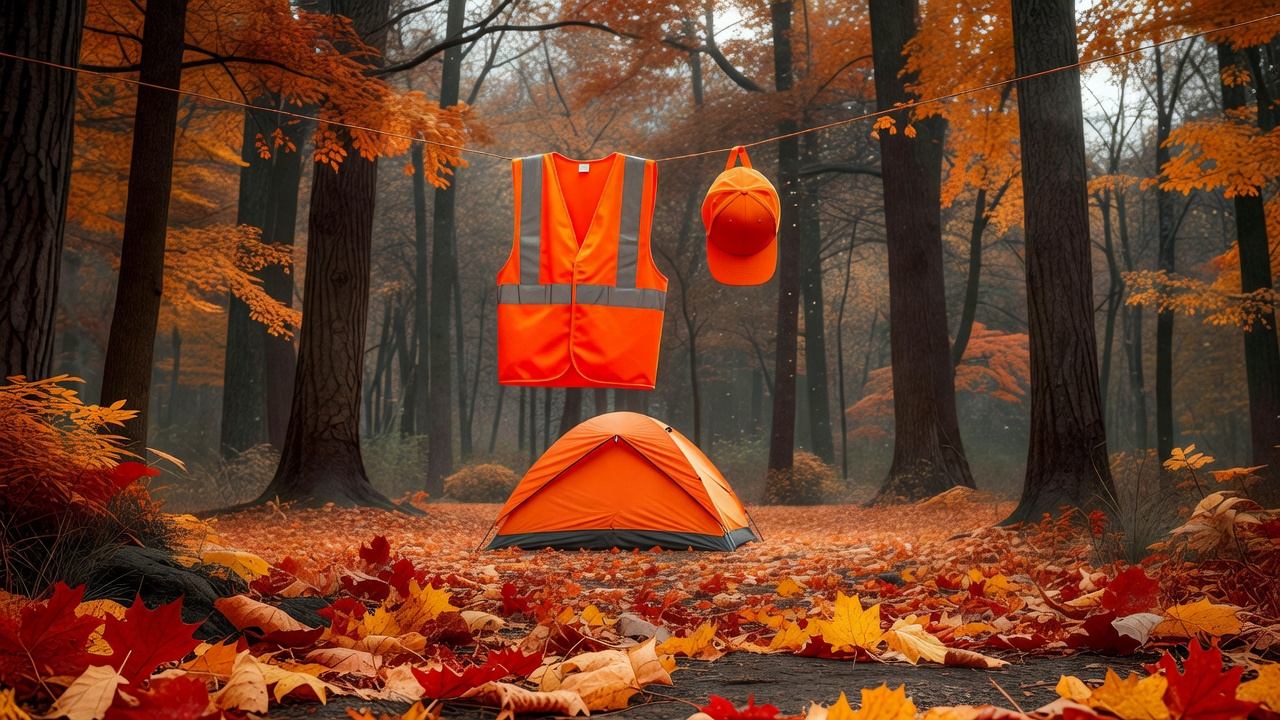
Forty-three of fifty states require hunters to wear blaze orange during firearm seasons, and non-hunters recreating in the same areas are either required to or strongly urged to do the same. Some states are explicit about it. Pennsylvania requires everyone recreating on State Game Lands from November 16 to December 16 to wear 250 square inches of blaze orange visible from all sides. Massachusetts advises all outdoor users to wear it during open seasons.
Practically, that means:
- A hat and a vest, not just a hat. Visibility from all sides is the standard, and a hat is only visible from a distance if your head is up.
- Fluorescent orange, not rust, not safety yellow. Blaze orange occupies a color space nothing in the woods does. That is the entire point.
- Not earth tones, not white, not brown or tan. White in particular is worth avoiding — it is the flash of a whitetail's tail.
- On your dog too. A blaze orange dog vest visible from all sides. Dogs move like game, at game height, in cover.
The 250-square-inch figure from Pennsylvania is a good default even where it is not the law: a standard vest plus a hat clears it comfortably.
Timing Is the Bigger Lever
Hunters are most active in the first and last two hours of daylight, when game moves. That is also, inconveniently, when most campers want to hike.
Shifting the day is the cheapest safety measure available. Start hikes mid-morning rather than at dawn. Be back at camp before the last light rather than hiking through it. Mid-day — roughly 10 a.m. to 3 p.m. — sees the least hunting activity and, in fall, has the best light and temperature anyway.
This is not about hiding. It is about not being a moving shape in low light in cover, which is the specific situation where mistakes happen.
Check What Is Actually Open Where You Are Going
"Hunting season" is not one thing. Archery, muzzleloader, and firearm seasons run at different times, for different species, on different parcels, with different rules — and they vary state to state, sometimes unit to unit within a state.
Before a fall trip, check the state wildlife agency's season calendar for the specific dates and the specific management unit. What you want to know is whether a firearm season for deer or elk is open during your dates, because that is the one that changes how you should behave.
Also worth knowing:
- Whether hunting is permitted on that land at all. National parks generally prohibit it. National forests, BLM land, national grasslands, state forests, and state wildlife management areas generally permit it. State parks vary widely — many allow it in designated areas or seasons.
- Sunday restrictions. Several states restrict or prohibit Sunday hunting, which makes Sunday a reliably quiet day to be out.
- Whether your campground sits inside a hunting unit. Developed campgrounds usually have a no-discharge buffer, but the trail leaving the campground often does not.
Camp Etiquette That Actually Helps
Make noise on the trail. Talking, whistling, or just not moving silently identifies you as human at a distance. This is the opposite of the advice you follow the rest of the year, and it is correct in November.
Keep dogs leashed. A loose dog ranging through cover during a firearm season is the single riskiest thing a non-hunter brings to public land in the fall.
Stay on trails. Predictable movement on established routes is far easier for a hunter to identify and account for than someone bushwhacking.
Do not camp in an obvious hunting spot. Field edges, saddles, and the ends of old logging roads are where people set up before dawn. If you pitch there, someone will walk in on you in the dark.
Be decent about it. Hunters have as much right to that ground as you do, and in most states their license fees fund the agency managing it. If you walk into someone sitting quietly, a quiet wave and a wide detour is the whole protocol.
Frequently Asked Questions
How much blaze orange should a camper wear during hunting season?
A blaze orange hat plus a vest, visible from all sides. Pennsylvania's 250-square-inch requirement on State Game Lands is a reasonable default even where no rule applies — a standard vest and hat exceeds it.
What time of day is safest to hike during hunting season?
Roughly 10 a.m. to 3 p.m. Hunting activity concentrates in the first and last two hours of daylight, when game moves and visibility is poorest.
Does my dog need blaze orange too?
Yes. Dogs move at game height through cover and are the most easily mistaken members of a camping party. Use a vest visible from all sides and keep the dog leashed.
Is hunting allowed where I camp?
It depends on the land. National parks generally prohibit it; national forests, BLM land, and state wildlife management areas generally allow it; state parks vary. Check the specific unit with the state wildlife agency before the trip.