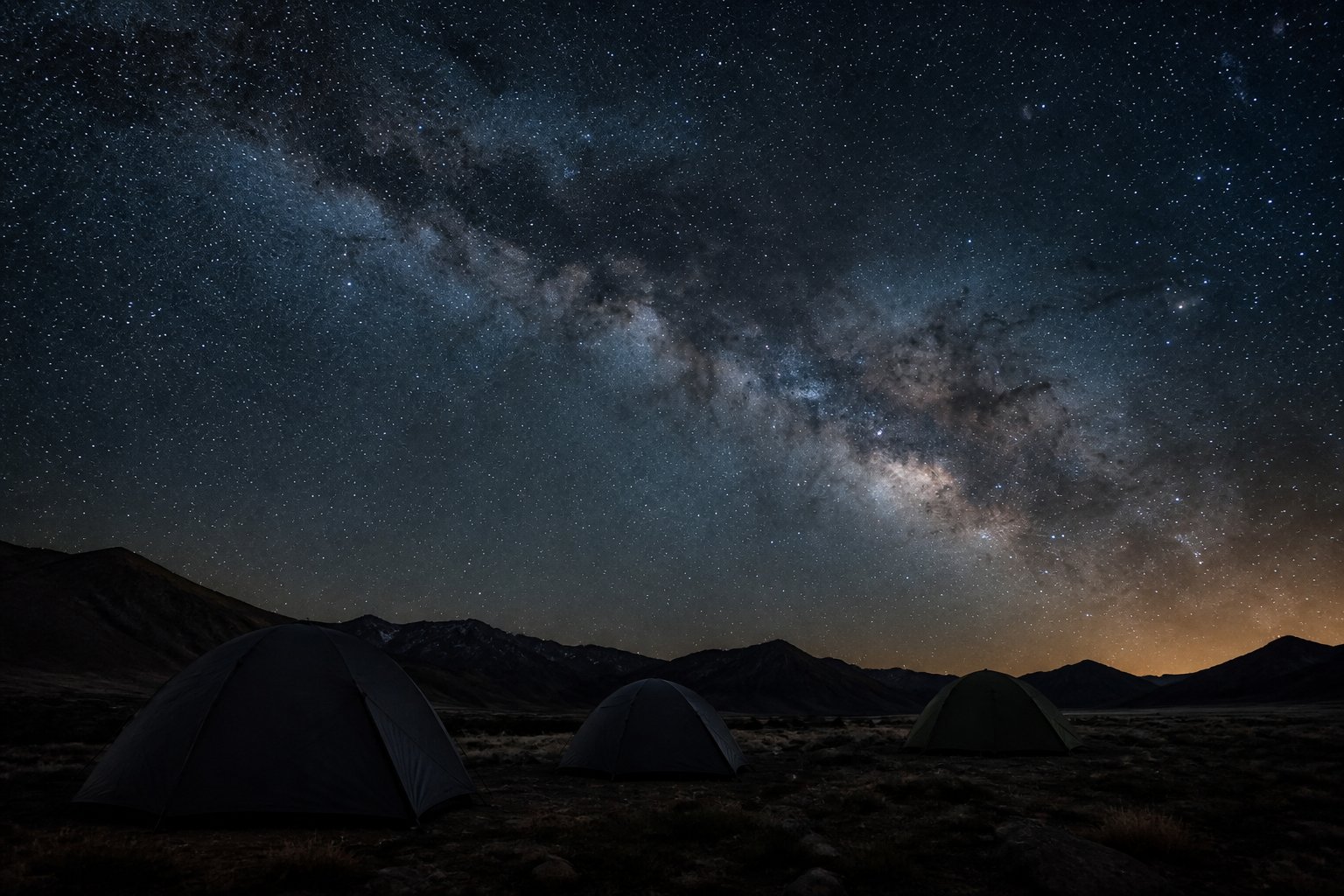
Most campers who say they want dark-sky camping actually want a clear night with a few bright stars visible from a campground that still has bathroom lights on until 10 pm. That is not dark-sky camping. True dark-sky camping means a sky dark enough to see the Milky Way cast a shadow — a threshold that eliminates roughly 80% of developed campgrounds in the continental US regardless of how rural they look on a map.
This guide covers the campgrounds where darkness is a managed resource — International Dark Sky Association (IDA) certified parks, adjacent campgrounds that benefit from protected darkness, and the planning variables (moon phase, light pollution, weather) that determine whether your reservation actually delivers the sky you booked for.
What Makes a Campground Dark-Sky Worthy
The International Dark Sky Association certifies parks, communities, and sanctuaries based on measured sky quality, lighting management policies, and public education commitments. Certification is not a marketing label — it requires documented sky brightness measurements (typically Bortle Class 1-3 for the darkest designations) and enforceable lighting ordinances.
For campers, three practical metrics matter more than certification status:
Bortle Scale class. A 9-point scale measuring night sky brightness. Class 1 is pristine dark sky. Class 5 is suburban — the Milky Way is faint or invisible. You want Class 3 or darker for meaningful Milky Way viewing. Class 1-2 delivers the experience most people associate with astrophotography and naked-eye nebula viewing.
Horizon light domes. A campground may have low local light pollution but sit within visual range of a city glow on one horizon. Big Bend has this problem on the northern horizon from Alpine and Marathon — the zenith sky is pristine, but long-exposure photos show a faint dome. Cherry Springs in Pennsylvania has a similar issue from Williamsport to the east, though the park manages it actively.
Campground lighting policy. A dark-sky park with unshielded bathroom floodlights and campers running LED string lights defeats the purpose. The best dark-sky campgrounds enforce red-light-only policies after a set hour and use fully shielded, downward-facing fixtures.
Check current conditions on the Light Pollution Map before booking — it overlays Bortle classes on a navigable map and updates with satellite data.
Big Bend National Park and the Big Bend Region
Big Bend is the flagship dark-sky destination in the lower 48 — an IDA International Dark Sky Park since 2012, with Bortle Class 2 skies across most of the park and Class 1 conditions in the backcountry.
Chisos Basin Campground is the most developed option, nestled in a mountain basin at 5,400 feet. The surrounding Chisos Mountains block horizon light effectively, and the elevation delivers cooler nights than the desert floor. Tradeoff: the basin walls limit the sky dome to roughly 180 degrees — excellent for Milky Way core viewing to the south, less ideal for full-horizon astrophotography.
Rio Grande Village Campground on the desert floor at 1,850 feet has the widest horizon — 360-degree sky access with the Rio Grande and Mexico's Sierra del Carmen as silhouettes. Hotter nights (often 80°F+ lows in summer), but the open sky is unmatched for panorama photography. Winter and shoulder season (October through April) are the practical camping windows.
Cottonwood Campground near Castolon is the quietest developed option — 24 sites, no generators, minimal lighting, and direct access to the river corridor. It fills less quickly than Chisos Basin and Rio Grande Village, making it the insider pick for stargazers who prioritize darkness over amenities.
Adjacent options outside the park include Stillwell Store and RV Park and Big Bend Ranch State Park campgrounds — both benefit from the same regional darkness with less reservation competition than NPS campgrounds.
Moon phase planning for Big Bend: The Milky Way core is visible above the southern horizon from March through October, peaking in June and July. New moon weekends during this window are the highest-demand dates — book six months out or target the week before or after new moon when the sky is still 90% dark but reservation pressure drops.
Cherry Springs State Park and the Pennsylvania Dark Sky
Cherry Springs State Park in north-central Pennsylvania is the only IDA International Dark Sky Park on the East Coast — a remarkable designation given the population density within 200 miles. The park sits on a 2,300-foot plateau in the Susquehanna River headwaters, surrounded by the Susquehannock State Forest.
Cherry Springs Rustic Campground has 30 sites on the plateau itself. This is not a casual camping experience — sites are primitive (pit toilets, no showers, no electric), and the park actively manages for astronomy use. White light is discouraged after dark. The Astronomy Field (separate from the campground) hosts dedicated observer setups with power pedestals and red-light-only enforcement.
The campground books through the Pennsylvania state park system. Peak dates — new moon weekends from May through September — require reservations months ahead. Weekday nights and moon-phase-adjacent weekends are significantly easier to secure.
Adjacent options: Lyman Run State Park and Ole Bull State Park are within 30-45 minutes and offer more developed camping infrastructure if Cherry Springs is booked. Sky quality is Bortle Class 3-4 at these locations — noticeably brighter than Cherry Springs itself but still respectable by East Coast standards.
The East Coast dark-sky reality: even Cherry Springs shows horizon glow from distant cities on clear nights. Manage expectations accordingly. You will see the Milky Way clearly. You will not get Big Bend-level zenith darkness.
Other IDA Dark Sky Campgrounds Worth Booking
Natural Bridges National Monument, Utah — IDA's first International Dark Sky Park. Thirteen first-come-first-served sites beneath Owachomo Bridge at Bortle Class 2.
Death Valley National Park — Mesquite Spring and Wildrose Campground at higher elevation deliver Class 1-2 skies with less campground lighting than Furnace Creek.
Great Basin National Park, Nevada — Among the darkest in the lower 48. Remote, high elevation, genuinely cold at night even in July.
Moon Phase and Weather Planning
Dark-sky camping requires calendar planning that most campground guides ignore.
New moon is non-negotiable for Milky Way trips. The moon washes out fainter stars and nebulae even when it is below the horizon during early evening. Target the three nights centered on new moon for primary viewing. The week before new moon (waning crescent) and the week after (waxing crescent) are acceptable secondary windows with 1-2 hours of dark sky before moonrise or after moonset.
Weather is the other gate. Clear-sky fraction maps (check Clear Dark Sky for astronomy-specific forecasts at individual sites) predict cloud cover and atmospheric transparency. A Class 1 sky with 60% cloud cover delivers nothing. Build a one-night buffer into your itinerary when possible — dark-sky camping rewards flexibility.
Seasonal Milky Way visibility. In the northern hemisphere, the Milky Way core (the bright, photogenic section) is above the horizon from roughly March through October, visible in the southeastern sky after midnight in spring and due south by mid-evening in summer. Winter dark-sky trips still deliver excellent viewing — Orion, the Pleiades, and the Andromeda Galaxy are winter highlights — but not the Milky Way panorama most campers expect.
For general campground booking strategy including high-demand dates, see our campground booking tips.
Frequently Asked Questions
What is the darkest campground in the United States? Great Basin National Park and Big Bend National Park rank among the darkest in the lower 48 with Bortle Class 1-2 skies. Great Basin is more remote; Big Bend offers more accessible infrastructure.
Do I need special equipment for dark-sky camping? No. A dark site and clear weather are sufficient for naked-eye viewing. A reclining chair, red-light headlamp, and star chart help. Astrophotography requires a tripod and camera with manual exposure control.
How does moon phase affect dark-sky camping? Moonlight washes out fainter stars and nebulae. Plan Milky Way trips within three days of new moon. Crescent phases provide 1-2 hours of dark sky before moonrise or after moonset.
Can you see the Milky Way from Cherry Springs State Park? Yes — clear Milky Way visibility on moonless nights from May through October. Horizon glow from distant cities is visible but does not prevent viewing.
When is the best time of year for dark-sky camping? June through August for longest Milky Way hours. Shoulder seasons combine dark skies with fewer crowds. Winter delivers the longest nights but requires cold-weather preparation.