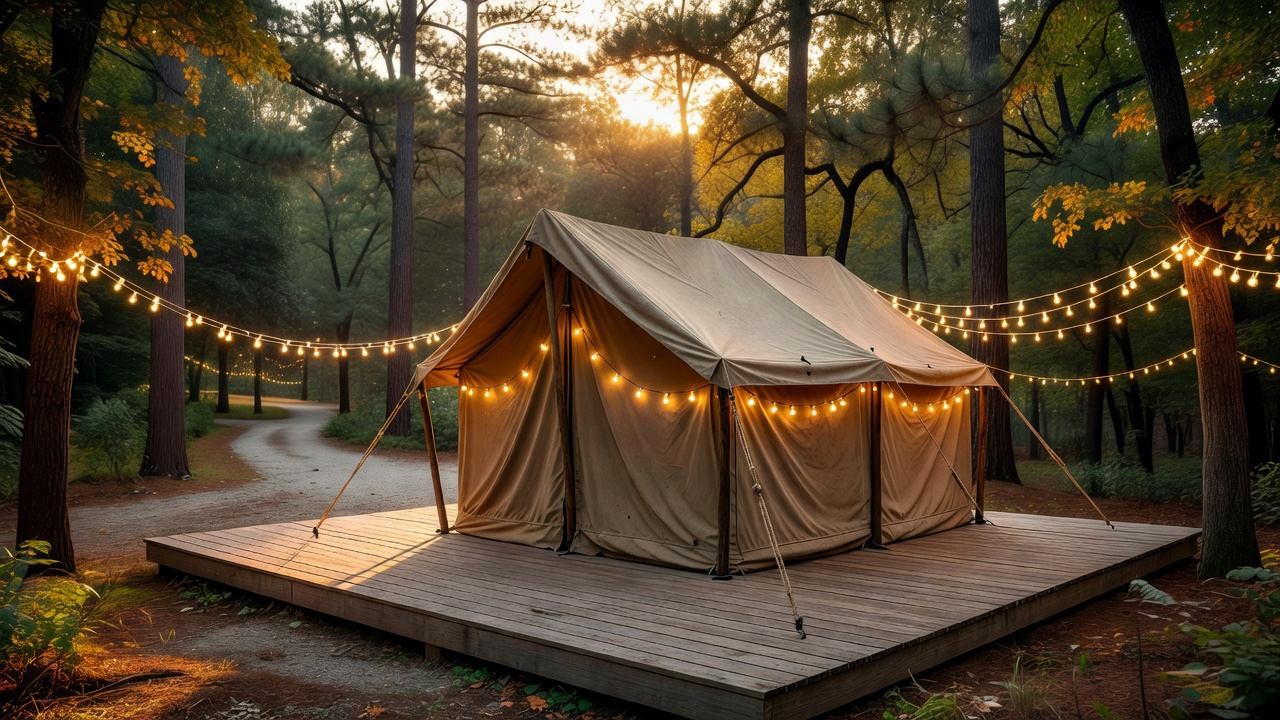
A growing number of ordinary campgrounds — the kind with a gravel loop, a bathhouse, and a camp store selling firewood and bug spray — have added a handful of canvas safari tents, a dome or two, or a row of small cabins along the back of the property. They are not glamping resorts. They are regular campgrounds with three to eight units that cost several times what the tent sites next to them do.
If you are considering one, the useful question is not "is glamping worth it" but "what am I paying for at this specific place," because the answer varies enormously.
The 2026 Numbers
Industry pricing data for 2026 puts average nightly rates roughly as follows:
| Structure | Average nightly rate |
|---|---|
| Bell tent | ~$107 |
| Safari tent | ~$136 |
| Yurt | ~$147 |
| Treehouse | ~$167 |
| Covered wagon | ~$169 |
| Geodesic dome | ~$185 |
Those are averages across a wide market, and the spread underneath them is large. Budget bell tents and simple cabins run $50–$150 a night. Mid-range safari tents and domes typically land in the $150–$400 range for two guests. Premium and luxury builds climb past $400 and, at the top end, past $1,000.
Regionally, the Midwest is consistently the best value — rural tents and simple cabins in the $80–$150 band. Beach-adjacent sites run $170–$280 for pods, cabins, and safari tents, with premium coastal domes and treehouses at $280–$500 and up.
The industry-wide figure worth knowing is that glamping carries roughly a 13% premium over traditional camping. That number is a useful sanity check, because at most campgrounds the actual gap between a tent site and a safari tent is far larger than 13% — which tells you the premium is being driven by the high end of the market, not by the modest unit at your local campground.
Where the Real Cost Sits
The nightly rate is the number in the listing. It is frequently not the number on the invoice.
Cleaning and linen fees. Commonly $34–$44 per reservation. On a two-night stay that is a meaningful percentage. On a one-night stay it can be 30% of the base rate. This is the single most common surprise.
Whether bedding is included at all. Some safari tents come with made beds. Others give you a mattress and expect you to bring your own bedding — which is fine if you knew, and a problem at 9 p.m. if you did not. This is the question to ask before booking, not the one to discover on arrival.
Activity and amenity wristbands. Kayak and paddleboard access, heated pool, game room, and similar are frequently sold separately, often around $20 per person. At a family-oriented campground these add up faster than the accommodation difference.
Fire pits and grills. Usually included with the site, sometimes not. Firewood is essentially never included.
Occupancy limits. Glamping units are often priced for two, with per-person charges beyond that. A family of four in a safari tent priced at $136 for two may be looking at considerably more.
What Actually Distinguishes a Good Unit
Having stayed in a fair number of these, the price tells you very little. Three things do.
Climate control. A canvas safari tent in August without a fan or air conditioning is an unpleasant place to sleep, and a canvas tent in October without a heater is worse. Whether the unit has a working climate system for the season you are booking matters more than every aesthetic feature combined. Campgrounds that added glamping units for the shoulder season without adding heat are common.
Bathroom arrangement. Some units have private bathrooms. Many — probably most at ordinary campgrounds — do not, and you are walking to the same bathhouse the tent campers use. That is entirely fine, but it is a different product than the listing photos usually suggest, and it should be reflected in what you are willing to pay.
Where the unit sits on the property. Glamping units at retrofitted campgrounds are frequently placed wherever there was room, which is often the least desirable corner — next to the maintenance yard, beside the entrance road, or in the loop with no tree cover. A $180 dome in a gravel lot is a worse night than a $32 tent site under trees.
When It Genuinely Makes Sense
The honest case for these units at a traditional campground is narrower than the marketing suggests, but it is real.
They work well for first-time campers who are not sure they will like it and are not prepared to buy a tent, pads, and sleeping bags to find out. They work for mixed groups where some people are camping and one or two are not going to sleep on the ground. They work for shoulder-season and bad-weather trips, where a hard-sided cabin or a heated tent turns a miserable forecast into a fine weekend. And they work when you are arriving late and do not want to pitch in the dark.
They make much less sense as a straight upgrade for experienced campers with their own gear. At $136 to $185 a night against a $25 to $35 site, the money is generally better spent on more nights.
Frequently Asked Questions
How much do glamping units cost per night in 2026?
Averages run roughly $107 for a bell tent, $136 for a safari tent, $147 for a yurt, $167 for a treehouse, $169 for a covered wagon, and $185 for a geodesic dome, with budget options from $50 and premium builds well past $400.
What fees get added on top of the nightly rate?
Cleaning and linen fees commonly run $34–$44 per reservation. Activity wristbands, pool or game-room access, extra-occupant charges, and firewood are frequently separate.
Is bedding included in a safari tent?
Not always. Some units are fully made up; others provide a mattress only. Confirm before booking — it is the most common source of arrival-day disappointment.
Is glamping worth it compared to a regular campsite?
It makes sense for first-time campers, mixed-comfort groups, shoulder-season trips, and late arrivals. For experienced campers who already own gear, the price gap is usually better spent on additional nights.