A red flag warning does not mean a fire is burning near your campground. It means the National Weather Service has identified weather conditions — typically strong winds, low humidity, and dry fuels — that can turn a small spark into a fast-spreading wildfire within hours. For campers planning summer trips across the West, the Southwest, and even parts of the northern Plains, these alerts are now routine background noise. The question is not whether you will encounter one, but whether you know how to read one before you leave home.
What a Red Flag Warning Actually Says
The National Weather Service issues red flag warnings when critical fire weather conditions are occurring or expected within the next 24 hours. The alert covers a defined geographic zone, a time window, and the specific weather drivers: wind speed and direction, relative humidity percentages, and sometimes temperature.
Read the full text, not just the headline. A warning for "southwest winds 20–30 mph with gusts to 55 mph and humidity as low as 10%" tells you something different from a warning driven by dry lightning or extreme heat. The NWS product also names affected fire weather zones — often county-level or sub-county polygons — which you can cross-reference against your destination on the NWS fire weather map.
Important distinction: a red flag warning is not the same as a fire restriction stage. Federal and state land agencies use Stage 1, Stage 2, and Stage 3 fire restrictions (or full area closures) on their own schedules. A campground may sit inside a red flag zone while a separate county burn ban or forest-wide Stage 2 restriction also applies. You need both layers.
Before You Pack: The Pre-Trip Checklist
Start three to five days before departure, then recheck the morning you leave.
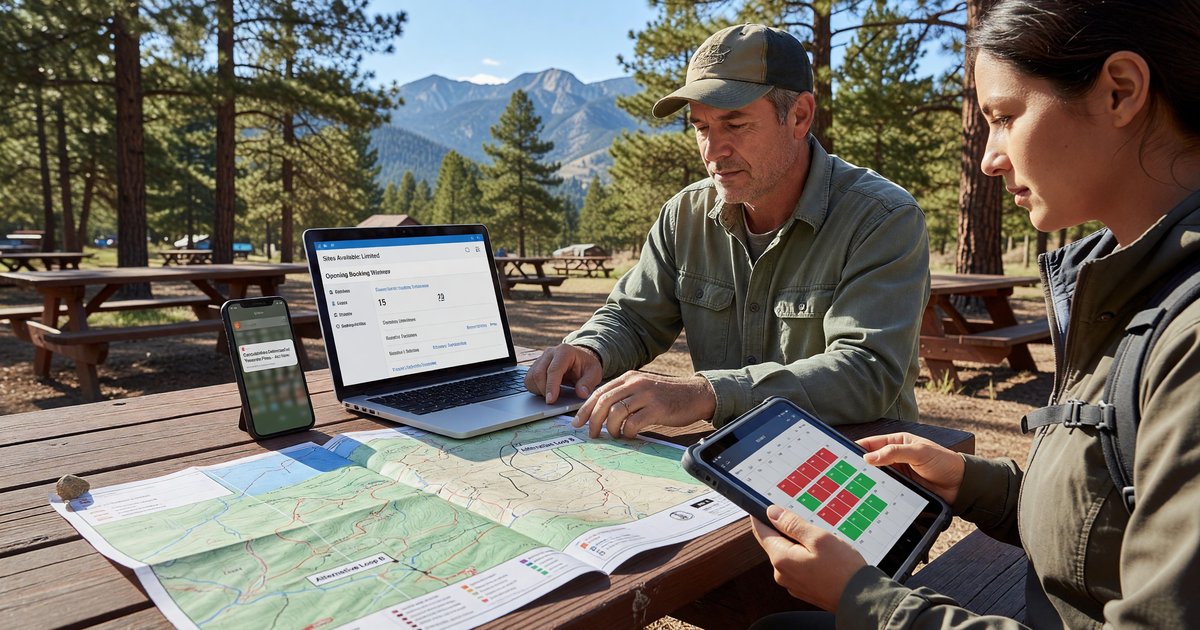
Check weather.gov for your destination county. Enter the nearest town or the campground coordinates. Look under "Active Alerts" for red flag warnings, fire weather watches, and excessive heat warnings that compound fire risk.
Check the managing agency's fire page. National forests post current restriction levels on their websites. Recreation.gov listings sometimes note fire bans in the alerts section, but do not rely on the booking confirmation alone — restrictions can change after you reserve.
Call the ranger district or campground host. For developed campgrounds on federal land, a five-minute phone call resolves ambiguity that websites lag on. Ask specifically: Are campfires allowed in the metal rings? Are portable fire pits permitted? Is the campground itself open, or only the access road?
Review your cancellation policy. Many public campgrounds allow free cancellation up to a few days before arrival. Private RV parks vary. Knowing your exit cost before a warning appears makes the go/no-go decision cleaner.
When to Cancel vs. When to Adjust
A red flag warning alone does not automatically mean cancel the trip. It means eliminate every ignition source and accept that fire behavior, if a fire starts anywhere in the region, will be extreme.
Strong case for canceling or rerouting:
- Your planned activities center on campfires, charcoal cooking, or dispersed camping without a developed site
- The warning covers the entire window of your stay with no relief forecast
- Local officials have closed trails, forests, or campgrounds (common during extended warning periods in California, Arizona, and New Mexico)
- You are towing an RV through warning zones where roadside grass fires from hot exhaust or dragging chains are a documented risk
Trip can proceed with modifications:
- You are staying in a full-hookup RV site and will cook on propane indoors or on electric only
- The warning expires before your arrival and no extension is forecast
- Your campground is in a irrigated, low-fuel environment (some desert basin sites) while the warning targets adjacent mountain zones you will not enter
Never interpret "the campground has fire rings" as permission during a red flag event. Snohomish County, Washington, explicitly notes that red flag warnings ban all recreational fires even when a broader burn ban is already in place. Minnesota DNR has prohibited campfires in enhanced restriction counties during warnings. The ring being installed does not override the alert.
What To Do If a Warning Hits While You Are Already Camping
If a warning is issued mid-trip, treat it as an immediate operational change, not a suggestion.
Extinguish any open flame completely — drown, stir, drown again, and feel for heat. Do not leave coals "to die down." Switch to camp stove cooking with a shut-off valve. Avoid driving off-road through dry grass; hot catalytic converters and dragging trailer chains start fires every warning season.
Monitor local emergency notification systems. Many western counties use reverse-911 and opt-in alert portals (ReadySBC, Everbridge, county sheriff Facebook pages). Evacuation orders can precede visible flames when wind-driven fires move faster than traffic.
Have two exit routes mapped before you need them. One main road and one alternate that does not dead-end into the fire-prone drainage you came to enjoy.
How Red Flag Warnings Fit the Rest of Fire Season
Red flag warnings cluster in late spring through early fall, peaking when fuels are cured and monsoon or frontal wind patterns arrive. They often stack with smoke from existing fires — the Cottonwood Fire in Utah's Fishlake National Forest and concurrent warnings across California, Arizona, and New Mexico in July 2026 illustrate how campers can face alert fatigue while multiple incidents stress evacuation infrastructure.
Smoke and red flag conditions overlap but require different responses. Our wildfire smoke and air quality guide covers AQI thresholds and when to leave for health reasons. Red flag warnings cover ignition risk. A clear-skied day under a red flag warning is still a dangerous fire day.
Build the habit of checking fire weather the same way you check rain forecasts. The campers who avoid becoming statistics are not luckier — they read the alert text, believed it, and changed plans when the weather said fire would behave badly.