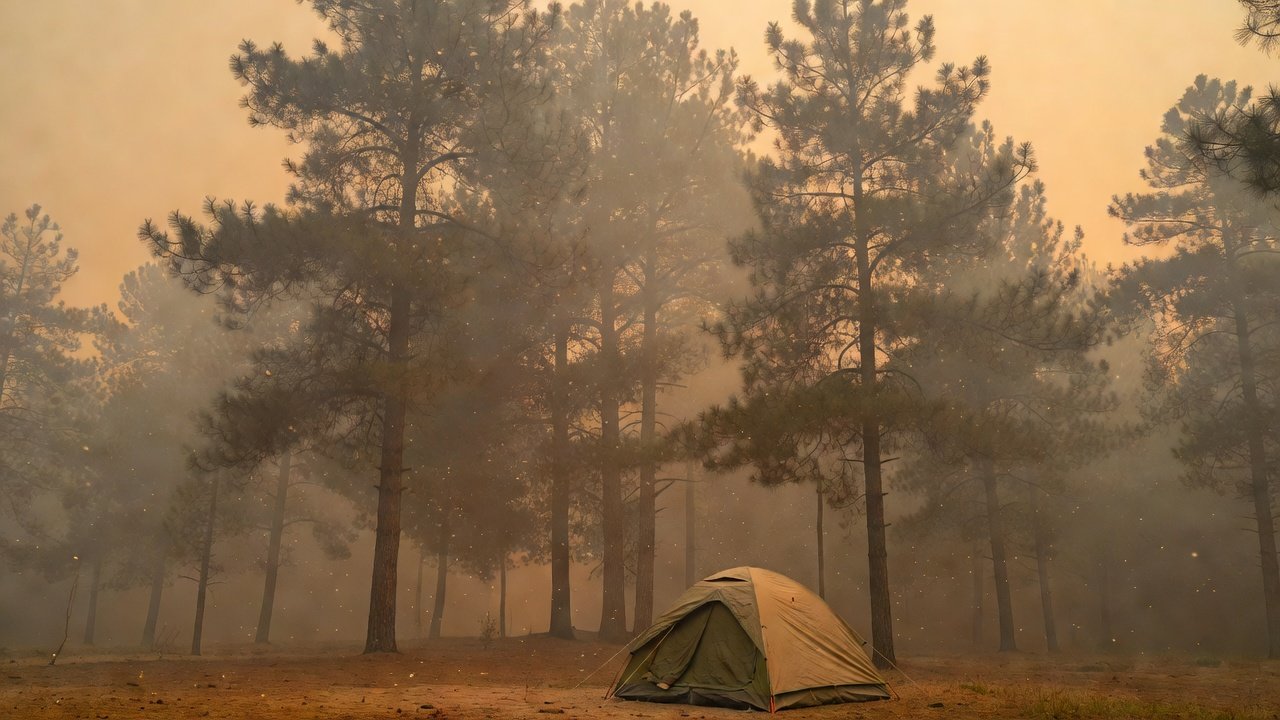
Wildfire smoke has become a regular feature of the North American camping season — not a freak occurrence but a predictable hazard that shows up across a wide geography, often on days that look fine until late afternoon. The 2026 fire season opened early and ran hard: by the start of June 2026, fires had already burned roughly 2.4 million acres across the US, nearly double the 10-year average for that point in the calendar. Minnesota's MPCA was forecasting extended smoky stretches for the summer. Utah wildfire season arrived a full month ahead of schedule.
If you camp in the western US, the northern Rockies, or even the Upper Midwest, wildfire smoke is now part of the planning equation. Knowing how to read air quality data before you leave home — and what to do when smoke arrives at camp — matters more than it once did.
How the Air Quality Index Works and What It Means for Campers
The Air Quality Index (AQI) is a standardized 0–500 scale used by the EPA to communicate how clean or polluted outdoor air is at a given location. For wildfire smoke, the relevant pollutant is fine particulate matter — PM2.5, particles small enough to penetrate deep into lungs. Every campsite activity you care about — sleeping outside, hiking, cooking over a fire — puts you in sustained outdoor exposure.
The key AQI thresholds:
0–50 (Good): No restrictions. Air is clean, outdoor activity is unrestricted.
51–100 (Moderate): Air quality is acceptable for most people. Those unusually sensitive to air pollution may want to reduce extended outdoor exertion.
101–150 (Unhealthy for Sensitive Groups): People with asthma, heart disease, or lung conditions should limit prolonged outdoor exertion. Children and older adults should take breaks. For healthy adults, short periods outdoors are still generally acceptable.
151–200 (Unhealthy): Everyone should reduce extended outdoor activity. At the campsite this means limiting physical output — hiking, paddling, mountain biking — and staying inside a tent or vehicle when smoke is visibly thick.
201–300 (Very Unhealthy): Avoid outdoor activity. This is a serious health threshold — even short outdoor exposure can cause respiratory distress in healthy individuals.
301+ (Hazardous): Emergency conditions. Leave the area if possible. The campsite is not a safe place to stay.
The primary tool for real-time monitoring is AirNow's Fire and Smoke Map, a joint EPA and USDA Forest Service resource that layers current fire locations, smoke plumes, and AQI readings by zip code or map location. It updates hourly and is the resource to bookmark before any camping trip in fire-prone regions. The California Air Resources Board maintains detailed state-level monitoring; equivalent resources exist for most western states.
Checking Air Quality Before and During Your Trip
The critical window for checking air quality is not the morning you arrive — it's 24 to 48 hours before departure. Smoke from a new fire several hundred miles away can descend on a campground faster than campsite-level forecasts catch up.
Before you leave:
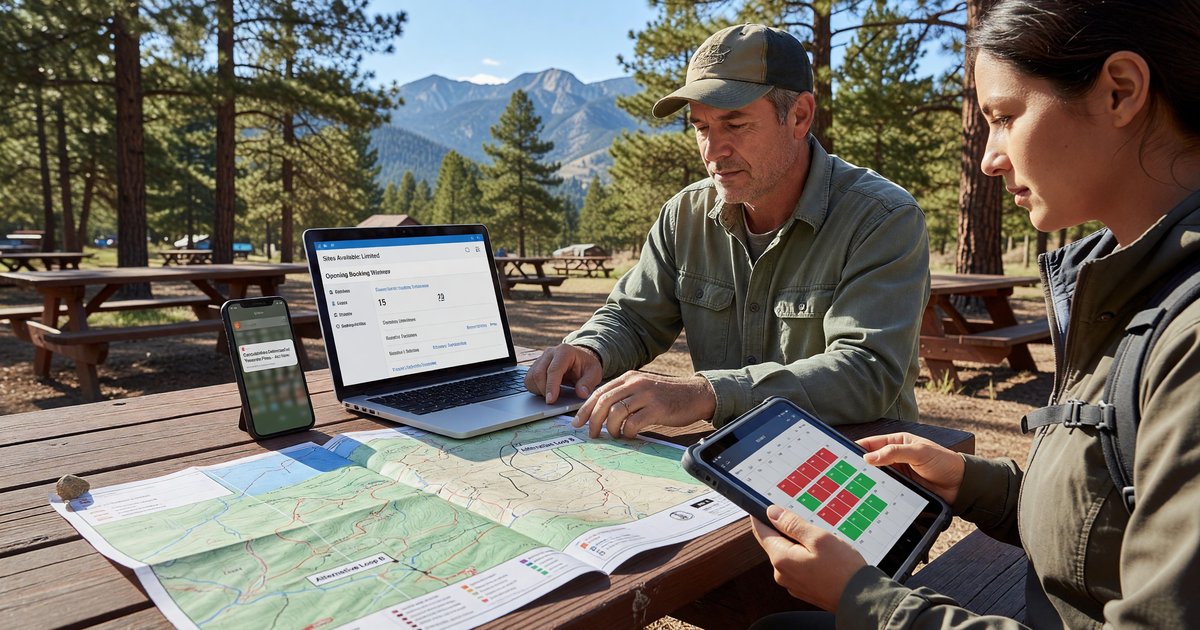
- Open AirNow.gov and check current and forecast AQI for your destination zip code.
- Pull up the Fire and Smoke Map and look at both current fire locations and the smoke forecast for the next 48 hours. Smoke moves with wind patterns and can arrive from fires hundreds of miles away that you'd never think to watch.
- Check the specific national forest or park's website. Many post real-time air quality advisories and will cancel campground reservations or issue refunds when conditions reach hazardous levels.
- Look at smoke forecast discussion products from the National Weather Service; they issue routine smoke forecasts for much of the western US during active fire season.
Once you're at camp, the check doesn't stop. Air quality can change in hours during active fire weather. Download the AirNow app or bookmark the Fire and Smoke Map on your phone and check morning and evening during smoky conditions.
What to Do at the Campsite When Smoke Arrives
If you're already at camp and smoke rolls in, you have a spectrum of options depending on severity.
When AQI is in the 100–150 range: Moderate your activity. Skip the long ridge hike and stay at lower elevation where air quality may be slightly better. Take breaks in your tent or vehicle when smoke is visible. Drink more water — smoke-irritated airways benefit from hydration. This level is manageable for most healthy adults for a day or two; reassess if it climbs.
N95 respirators are your best protection. A properly fitted N95 — not a cloth mask, not a surgical mask, not a bandana — is rated to filter at least 95% of airborne particles in the PM2.5 size range. Bring at least one per person for any camping trip in fire-prone areas from late June through October. The fit matters: the mask needs to seal against your face without gaps. Facial hair significantly reduces effectiveness.
Ventilate cautiously. Tent mesh provides minimal filtration against smoke. In heavy smoke conditions, keeping your tent's rainfly closed reduces smoke intrusion. Your vehicle is your best refuge — modern vehicles with recirculated air mode filter better than ambient conditions outside.
Campfires during wildfire smoke. Adding campfire smoke on top of wildfire smoke is compounding the problem. Reconsider your campfire when AQI is already elevated — you're adding more PM2.5 to an already loaded air column. Many active fire restriction periods also prohibit campfires regardless of your preferences.
Sensitive Groups and Higher-Risk Situations
The AQI thresholds for "Sensitive Groups" include people with asthma, chronic obstructive pulmonary disease (COPD), heart disease, and those who are pregnant. Children and people over 65 also face heightened risk because their respiratory and cardiovascular systems are either still developing or are less resilient. If your camping group includes anyone in these categories, your decision threshold for canceling or leaving needs to move down the scale — an AQI of 120 that a healthy adult manages reasonably well can be a significant health event for a child with asthma.
Know the symptoms: shortness of breath, chest tightness, unusual coughing, headache, and burning eyes are all signs of smoke exposure affecting your respiratory system. These are your signal to go inside or leave.
When to Change Your Plans
This is the harder question, and it's genuinely situational. A few principles:
AQI forecast above 150 for your arrival day or the majority of your trip: Reschedule. This is not caution-theater — this is the EPA's threshold for "unhealthy for everyone," and sustained exposure at a campsite during that range causes real health effects.
Rapidly worsening conditions mid-trip: Leave earlier than planned. Smoke events can escalate fast during active fire weather. Committing to a reservation is not a reason to stay in hazardous conditions.
Official closures and evacuation orders: If the managing agency closes the campground or an evacuation order is issued, there is no debate. Leave promptly, follow the designated evacuation route, and don't assume you'll have advance notice — fire behavior during high-wind conditions can be unpredictable.
AQI in the 100–150 range with stable forecast: Your call, with appropriate precautions. Many camping trips happen with some smoke; it's a matter of monitoring, modifying activities, and having a clear decision point pre-agreed if it worsens.
The EPA's Wildland Fires and Smoke resource page consolidates guidance on health effects, protection measures, and the fire and smoke monitoring tools in one place. It's worth bookmarking before any western camping season.
Smoke is rarely the only hazard in play during peak fire season — the same heat waves that dry out fuels also drive the extreme temperatures behind incidents like the 2026 Grand Canyon heat deaths. See our guide to heat safety at desert and canyon campgrounds for how to recognize heat illness and plan around it.
Pack the N95s. Check the map before you leave. Know your group's health situation. And be willing to adapt — a smoky campground is a real tradeoff, and you're the one best positioned to make the call.
Frequently Asked Questions
What AQI level is safe for camping outdoors? AQI 0–100 is generally safe for healthy adults. At 101–150, sensitive groups (respiratory conditions, children, older adults) should reduce exertion. At 151+, everyone should limit outdoor activity; at 201+, leaving the area is the right call.
Where do I check air quality before my camping trip? Use AirNow's Fire and Smoke Map — it layers fire locations, smoke plumes, and current AQI by location. Check 24–48 hours before departure to catch incoming smoke from distant fires.
Do cloth masks protect against wildfire smoke? No. Only an N95 respirator, properly fitted, filters PM2.5 particles effectively. Cloth masks, bandanas, and surgical masks do not provide meaningful protection from wildfire smoke.
Should I still have a campfire when smoke is present? Skip it when AQI is already elevated. Adding campfire smoke to wildfire smoke compounds your particulate exposure. Check current fire restrictions for your area — many are already in effect during active fire seasons.