You buy a sleeping bag rated well below the forecast low, zip in at a fall campsite, and still wake up at 2 a.m. with a cold back. The bag is rarely the problem. Down and synthetic fill compress under your body weight, so almost none of the insulation you paid for sits between you and the ground. That job belongs to the pad, and the number that describes how well it does it is R-value.
What R-value actually measures
R-value is a measure of resistance to heat flow. A higher number means the pad slows the transfer of body heat into the cold ground more effectively. Pad makers used to publish their own numbers using their own test methods, which made comparisons nearly meaningless. The industry moved to a shared lab protocol, ASTM F3340, in which a hot plate sits on one side of the pad and a cold plate on the other and the heat flow between them is measured. If a listing shows an R-value with "ASTM" next to it, the number can be compared across brands. Older or unlabeled figures may not be.
Two limits are worth knowing up front:
- R-value is not a temperature rating. Cascade Designs, which makes Therm-a-Rest pads, and other brands are clear that no R-value guarantees comfort at a particular temperature. Some people sleep warm and some sleep cold.
- The test is a lab condition. It does not account for a rumpled tent floor, a wet campsite, or how much of the pad your body actually covers.
Matching R-value to fall lows
Published guidance does not agree on a single chart, which is itself useful information. Klymit's retailer guidance calls R-values of 2 to 4 suitable for spring and fall and reserves 4.5 and above for winter. Several independent gear guides place three-season use higher, around R3 to R5, with winter at R5 and above. Both camps agree on the direction of travel: the colder the ground, the higher the number.
Here is a practical way to use those ranges for shoulder-season car camping and short trips:
- Lows in the 40s and 50s F (summer-to-early-fall): R2 to R3 is usually workable for most sleepers.
- Lows in the 30s F (typical October and early November nights in much of the northern U.S.): Aim for R3.5 to R5. The overlap of the published ranges is the safe zone.
- Lows around or below freezing, frozen ground, or frost on the tent: Treat it as winter and go to R5 or higher.
Then adjust for you. If you routinely sleep cold, are a smaller person with less body mass to warm the pad, or camp on bare rock, damp soil, or at elevation, move up one step. A few extra grams of pad are cheaper than a bad night.
Your bag's rating works with the pad rather than separately. Lab bag ratings assume a standardized pad underneath. If you want the other half of the equation, our guide to sleeping bag temperature ratings for fall and shoulder-season camping covers how to read Comfort and Lower Limit numbers.
Stacking pads: the cheap upgrade
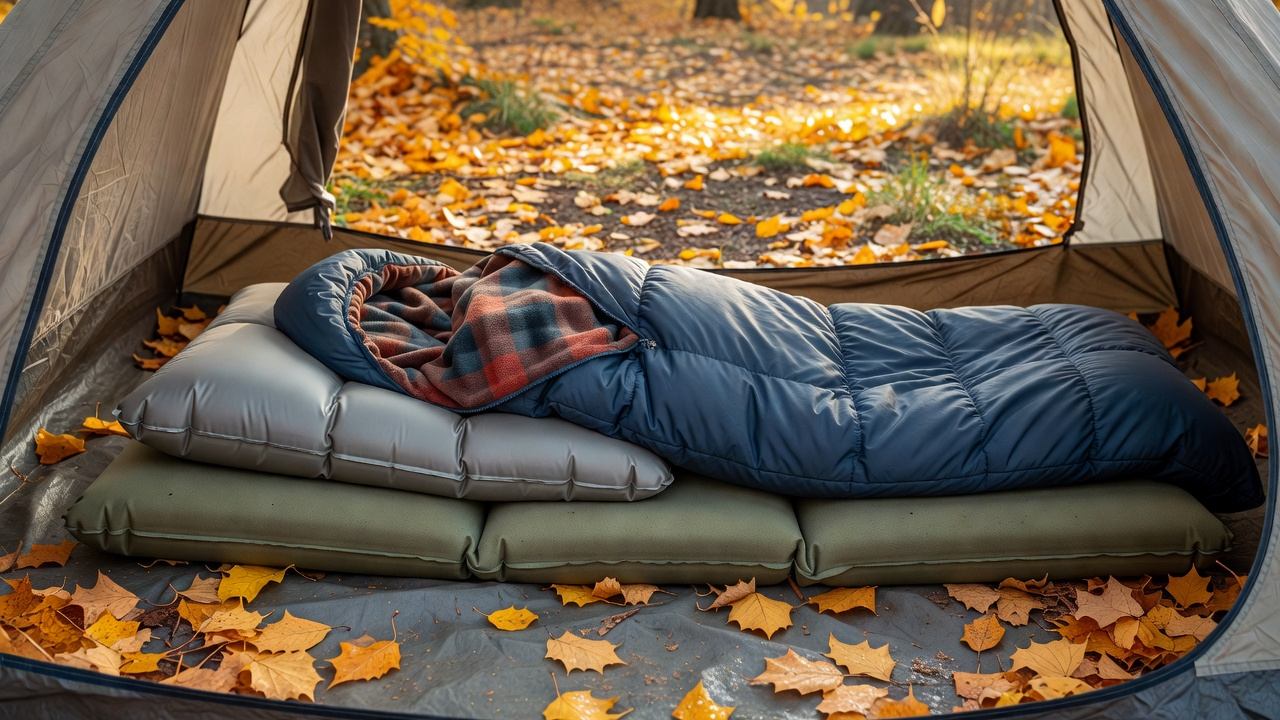
R-values of stacked pads add together, as long as there is no air gap between them. An R2 closed-cell foam pad under an R3 inflatable pad gives you roughly R5 of insulation. This is why many backpackers carry a thin foam pad as a base layer under an air pad even in mild weather.
A few details matter:
- Closed-cell foam on the bottom is the common approach. It protects the inflatable from punctures and adds a layer that cannot leak or lose loft.
- Placement is debated. One camp argues the foam should sit on top of the air pad; another says order does not matter if there is no gap. Either way, keep the pads flush and consider a groundsheet or tent floor that keeps them from sliding apart.
- Stacking is the right fix for a pad you already own. If you have a good R2 inflatable and an October trip, a foam sheet costs far less than replacing the pad.
Why a correct bag still fails on a thin pad
Insulation works by trapping still air, and a bag trapped beneath your weight has none to trap. Under your torso the fill is flattened, so the ground pulls heat out through a layer only a few millimeters thick. A pad with a low R-value, such as a summer-weight R2 or less, lets that heat drain all night while the bag keeps the air above you warm. That mismatch is why campers report a warm top and a cold back, and why upgrading the pad often fixes the problem faster than buying a heavier bag.
Fixing a bad pad before the trip
Check the pad before you blame the bag:
- Read the label. Find the ASTM R-value. If there is none, assume the pad is a summer pad.
- Inflate it and leave it overnight at home. A slow leak shows up as a soft pad in the morning, and a deflated pad has almost no insulating value.
- Test the foam-plus-inflatable stack in the living room. Make sure the two layers stay put when you roll over.
- Match the pad length to the cold. A torso-length pad leaves your legs on the ground. At fall temperatures, fill that gap with a folded foam pad or a pack under your feet.
What to take on your next fall trip
For shoulder-season lows in the 30s, pack a pad rated R3.5 to R5, or stack a foam pad under whatever inflatable you own. If you sleep cold, camp on cold ground, or expect frost, aim for R5. Verify that the rating carries the ASTM label, and treat the number as a floor for comparison, not a promise. A properly insulated pad under a bag that matches the forecast is the difference between a quiet night and a cold one.