NOAA's 2026 Atlantic outlook, issued May 21, gave a 55% chance of a below-normal season, 35% near-normal, and 10% above-normal, with El Niño expected to develop and suppress activity against slightly warmer-than-normal Atlantic sea surface temperatures.
That forecast is worth exactly one thing to an RVer parked in Florida or the Carolinas in September: nothing. A below-normal season means fewer named storms across a whole basin. It says nothing about whether one of them comes to where you are. Season totals are a climatological statistic; you experience a binary.
The season runs June 1 to November 30, and the peak — mid-August through late October — is happening now.
The Difference Between Watching and Monitoring
Most people follow hurricanes by seeing them on the news, which is the worst possible input for someone in a vehicle. By the time a storm is a news item, the decision window has narrowed.
What monitoring means in practice:
Check the National Hurricane Center daily during peak season, not when something is already named. The tropical weather outlook flags disturbances with formation probabilities days before anything gets a name. Those days are your planning margin.
Watch the forecast cone, and understand what it is not. The cone shows the probable track of the storm's center — historically the center stays inside it about two-thirds of the time. It is not a damage map. Impacts routinely extend well outside it, and being outside the cone is not being safe.
Sign up for county emergency alerts wherever you are staying, and re-register when you move. Evacuation orders are issued by county, and a state-level app will not tell you your specific zone has been called.
Know your evacuation zone before you need it. Coastal counties publish zone maps. Campgrounds and RV parks sit in specific zones and often do not advertise which.
Keep a NOAA weather radio. Cell service in coastal campgrounds degrades early in a storm event and fails entirely afterward.
The Rule That Makes RVs Different
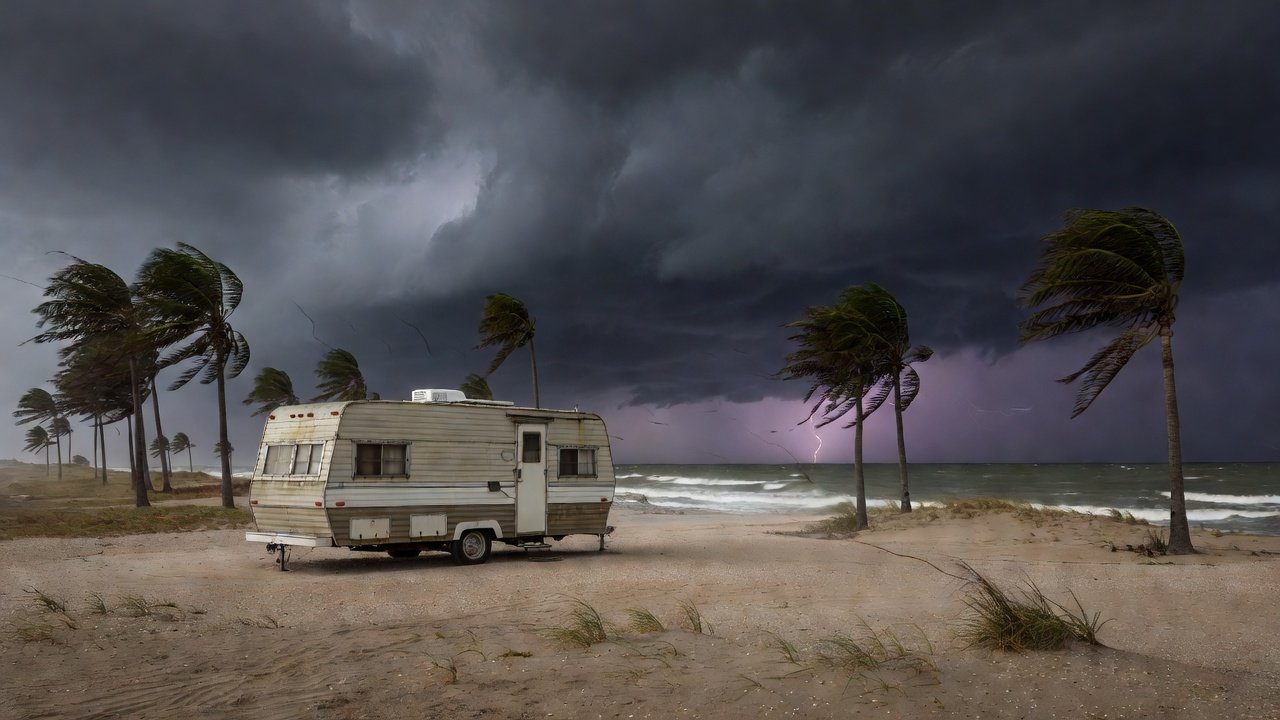
There is no version of riding out a hurricane in an RV that is defensible. A travel trailer or motorhome is a lightweight box with a large sail area, high center of gravity, and no structural anchoring. Tropical-storm-force winds — well below hurricane strength — are enough to move or roll one.
Mandatory evacuation orders for mobile homes and RVs are frequently issued earlier and at lower storm intensities than orders for permanent structures, for exactly this reason. Many coastal parks close and clear on their own schedule ahead of any county order.
The corollary is that an RV's advantage is real but perishable. You can leave, which a house cannot — but only while roads are open and fuel is available, and both fail well before landfall.
Build the Plan Before the Season, Not During the Storm
Set your own trigger, in advance, and make it earlier than you think. A workable rule for RVers: leave when a storm's forecast track puts you within the cone at 72 hours, without waiting for an evacuation order. Once orders go out, you are in traffic with everyone who waited.
Identify three inland destinations in different directions — north, west, and northwest — with confirmed availability. Inland state park campgrounds, county fairgrounds, and RV parks 150-plus miles from the coast fill fast when a storm threatens. Have their phone numbers, not just their names.
Keep the tank above half from August onward. Fuel stations along evacuation routes run dry, and the ones still open have long lines. Half a tank is the difference between choosing a route and taking whatever route you can reach.
Keep the rig road-ready. Tire condition and pressure checked, propane secured, awning retracted the moment a watch is issued, jacks and slides operable. An RV that needs an hour of work before it can move is an RV that leaves an hour late.
Carry physical documents. Registration, insurance, campground receipts, medication lists, and identification in a waterproof folder. Also physical cash — card systems fail with the power.
Provision for the road, not the storm. One gallon of water per person per day, non-perishable food, a manual can opener, a 14-day prescription supply, and a stocked first-aid kit. The scenario you are provisioning for is 200 miles of stopped traffic, not sheltering in place.
What to Do With the Rig If You Cannot Take It
Sometimes the tow vehicle is down, or the storm arrives faster than the plan. If you must leave an RV behind:
- Move it away from trees and power lines if the park allows repositioning.
- Point the nose into the forecast wind — the smallest profile forward.
- Retract slides and awnings, remove or stow anything exterior.
- Lower it onto its jacks or stabilizers to reduce sway, and chock the wheels.
- Photograph everything, inside and out, before you leave. Insurance claims after a storm move much faster with dated pre-event documentation.
Then go. A replaceable trailer is not worth staying for, and the people who die in these storms are overwhelmingly the ones who stayed a few hours too long trying to secure property.
Frequently Asked Questions
What did NOAA forecast for the 2026 Atlantic hurricane season?
NOAA's May 21 outlook gave a 55% chance of a below-normal season, 35% near-normal, and 10% above-normal, with El Niño expected to develop against slightly warmer-than-normal Atlantic sea surface temperatures.
Is it ever safe to ride out a hurricane in an RV?
No. RVs have a high profile, light construction, and no structural anchoring, and can be moved or rolled by tropical-storm-force winds well below hurricane strength. Evacuation orders for RVs are frequently issued earlier than for permanent structures.
When should an RVer evacuate ahead of a storm?
A practical trigger is leaving when the forecast track places you inside the cone at 72 hours, without waiting for an official order. Waiting for orders puts you in traffic behind everyone else who waited.
What does the forecast cone actually show?
The probable track of the storm's center — historically inside the cone about two-thirds of the time. It is not a map of where impacts occur, and significant wind, rain, and surge routinely extend well outside it.