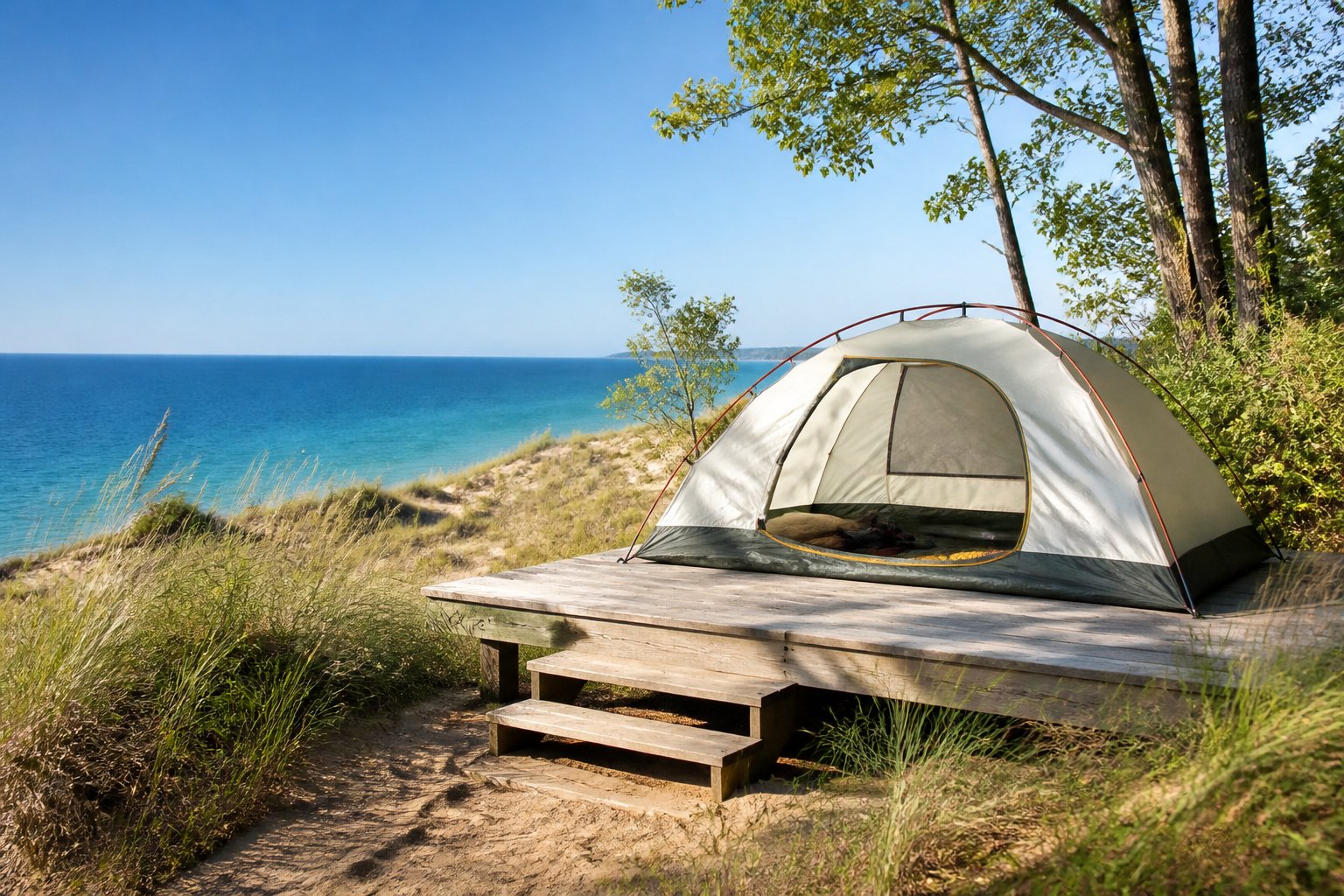
Great Lakes dune camping is a specific category of trip that looks straightforward on a map and becomes complicated the moment you arrive. You are camping on sand that moves, in wind that does not stop at sunset, above a freshwater sea that behaves more like an ocean than a lake when storms roll through. The campgrounds that work are the ones where managers understand dune ecology well enough to place sites in the right microclimate — and where campers understand that site selection matters more here than almost anywhere else in the Midwest.
This guide covers the dune campgrounds worth booking across the Great Lakes system, what the ecology means for your campsite, and the practical decisions that separate a memorable shoreline trip from a gritty, sleepless one.
Why Dune Campgrounds Are Different
Coastal dune systems on the Great Lakes are living landscapes. Lake Michigan and Lake Superior shorelines carry some of the largest freshwater dune complexes in the world — not the small, stabilized dunes you see behind a beach parking lot, but active parabolic dunes, perched dunes hundreds of feet above the water, and blowout areas where sand is actively migrating inland.
That ecology creates three camping realities:
Wind is structural, not incidental. Prevailing westerlies and northerlies off the lakes push sand, flatten tent walls, and amplify cold at night. A site that feels sheltered at 3 pm when you arrive may be fully exposed by morning.
Sand infiltrates everything. Zippers, stove burners, sleeping bag foot boxes, camera lenses. Dune campgrounds reward campers who treat sand as an environmental condition to manage, not a nuisance to ignore.
Access to the shoreline is not uniform. Some campgrounds sit directly behind primary dunes with boardwalk access. Others require a climb over loose sand that makes a cooler-and-camp-chair carry feel like a workout. Read the campground map before booking, not after arrival.
Sleeping Bear Dunes National Lakeshore
Sleeping Bear is the benchmark for Great Lakes dune camping — not because it has the most sites, but because the combination of perched dunes, Lake Michigan shoreline, and inland lakes creates a camping environment unlike anything else in the eastern US.
D.H. Day Campground is the primary developed option inside the national lakeshore. It sits in a mixed hardwood forest a short walk from Lake Michigan, with sites that vary dramatically in wind exposure. The loop closest to the lake gets more breeze and more sand; interior loops are quieter and better for families with young children. Sites on the outer edge of loops facing west take the brunt of afternoon wind — fine in shoulder season, punishing in July when lake breezes are constant.
Platte River Campground is the more versatile option, with river access, canoe and kayak put-ins, and a mix of electric and non-electric sites. It is farther from the iconic dune climbs but closer to the Platte River outlet into Lake Michigan — a productive area for morning paddles and evening swims when conditions allow.
The dune climbs at Sleeping Bear (Dune Climb, Empire Bluff Trail, Pyramid Point) are day-use attractions, not campground amenities. Plan your hiking for morning or late afternoon; midday sand surface temperatures on south-facing slopes can exceed 120°F in summer.
Booking: Sleeping Bear campgrounds book through recreation.gov. Peak summer dates (late June through August) require reservations months ahead. Shoulder season — mid-September through mid-October — delivers the best combination of manageable crowds, stable weather, and golden dune grass without peak black fly season.
Indiana Dunes State Park and National Park
Indiana Dunes compresses a surprising amount of dune diversity into a small geographic footprint along the southern shore of Lake Michigan, roughly an hour from Chicago. The state park campground and the national park's Dunewood Campground operate under different reservation systems but serve the same landscape.
Indiana Dunes State Park Campground has roughly 140 sites in a wooded dune-and-swale landscape — a topography of alternating sandy ridges and wet depressions that supports unusual plant communities. Sites in the interior loops are more sheltered; perimeter sites get lake breeze and more traffic noise from nearby day-use areas. The state park reservation system (camp.in.gov) is generally less competitive than recreation.gov for equivalent dates.
Dunewood Campground in Indiana Dunes National Park is smaller (66 sites), more secluded, and consistently underrated. It sits in a forested dune landscape away from the busiest beach areas, with access to the Cowles Bog Trail and other hiking that most visitors skip in favor of Mount Baldy. If you want dune ecology without beach-town density, Dunewood is the pick.
The dune-and-swale system here supports over 1,100 plant species. Stay on designated trails — off-trail hiking damages marram grass that stabilizes active dunes.
Pictured Rocks and Lake Superior Dune Country
Pictured Rocks National Lakeshore on Michigan's Upper Peninsula is primarily known for sandstone cliffs, sea caves, and agate beaches — but the campgrounds adjacent to the lakeshore sit in a Lake Superior dune-and-forest matrix that shares ecology with the lower lakes while operating at a different temperature and weather scale.
Twelvemile Beach Campground is the standout for dune-adjacent camping within Pictured Rocks. It sits on a bluff above Lake Superior with walk-down access to a long, undeveloped beach. Sites are widely spaced compared to lower-lakes campgrounds, and the Lake Superior microclimate means fewer 90°F nights and more unpredictable weather at any time of year. Bring layers, not just a swimsuit.
Hurricane River Campground is smaller and closer to the park's western attractions. Lake Superior surface temperatures rarely exceed 60°F even in August — bring layers, not just a swimsuit. Stay on designated trails; off-trail hiking on active dunes damages marram grass that stabilizes the system.
Site Selection: A Practical Framework
When you have a choice of sites, apply this order of priority:
Shelter from prevailing wind. Look for sites backed by tree cover on the western or northwestern side of the loop. A single row of mature trees makes a measurable difference in tent stability and sleep quality.
Distance from foot traffic corridors. Boardwalks to beaches concentrate traffic from 8 am to sunset. Sites adjacent to these corridors get sand tracked in constantly and rarely feel private.
Pad elevation and drainage. Sandy pads in low swales collect water after rain. Higher pads drain faster and stay firmer for tent stakes.
Shade vs. sun tradeoff. Full-shade sites stay cooler in summer but feel damp in shoulder season. Partial shade is the versatile pick for multi-day stays.
For campground booking strategy across state and national systems, see our state park camping reservations guide.
Frequently Asked Questions
What is the best Great Lakes dune campground for first-time visitors? Indiana Dunes State Park Campground is the most accessible entry point — close to Chicago, well-maintained infrastructure, and manageable reservation competition. Sleeping Bear Dunes delivers the most dramatic landscape but requires earlier booking and more sand management.
When is the best time to camp at Great Lakes dune campgrounds? Mid-September through mid-October is the best window — fewer insects, smaller crowds, and fall color. Late June through July brings peak crowds and black fly season in northern locations. Lake Superior campgrounds are most reliable in July and August.
How do you keep sand out of your tent at dune campgrounds? Set up a brush-off station at the entrance, remove shoes before entering, shake out your footprint daily, and wipe feet at the door. Avoid fully closing zippers when sand is present — it damages zipper teeth.
Can you camp directly on the dunes at Sleeping Bear or Indiana Dunes? No. Developed campgrounds sit in backdune forest. Backcountry camping at Sleeping Bear requires a permit for designated zones only. Camping on undesignated dune slopes is prohibited and damages stabilization vegetation.
Are Great Lakes dune campgrounds good for RV camping? Most accommodate RVs with length limits of 35-45 feet. Smaller campgrounds like Dunewood and Twelvemile Beach favor smaller rigs on sandy or narrow roads. Expect sand in exterior compartments regardless of rig size.